


Investing in the stock market isn’t just “buying stocks.” It’s buying a piece of the real economy — and the economy is divided into large families of activity that don’t all react the same way to recessions, inflation, or growth.
To keep it organized, markets use the GICS classification (Global Industry Classification Standard, developed by S&P and MSCI), which splits the economy into 11 sectors. Understanding them is the first step to building a diversified, balanced portfolio.
Because this is The Yield Dealer, every example below is a US Dividend King or Dividend Aristocrat — companies that have raised their dividend for decades. (A Dividend Aristocrat is an S&P 500 company with 25+ straight years of increases; a Dividend King has 50+.)
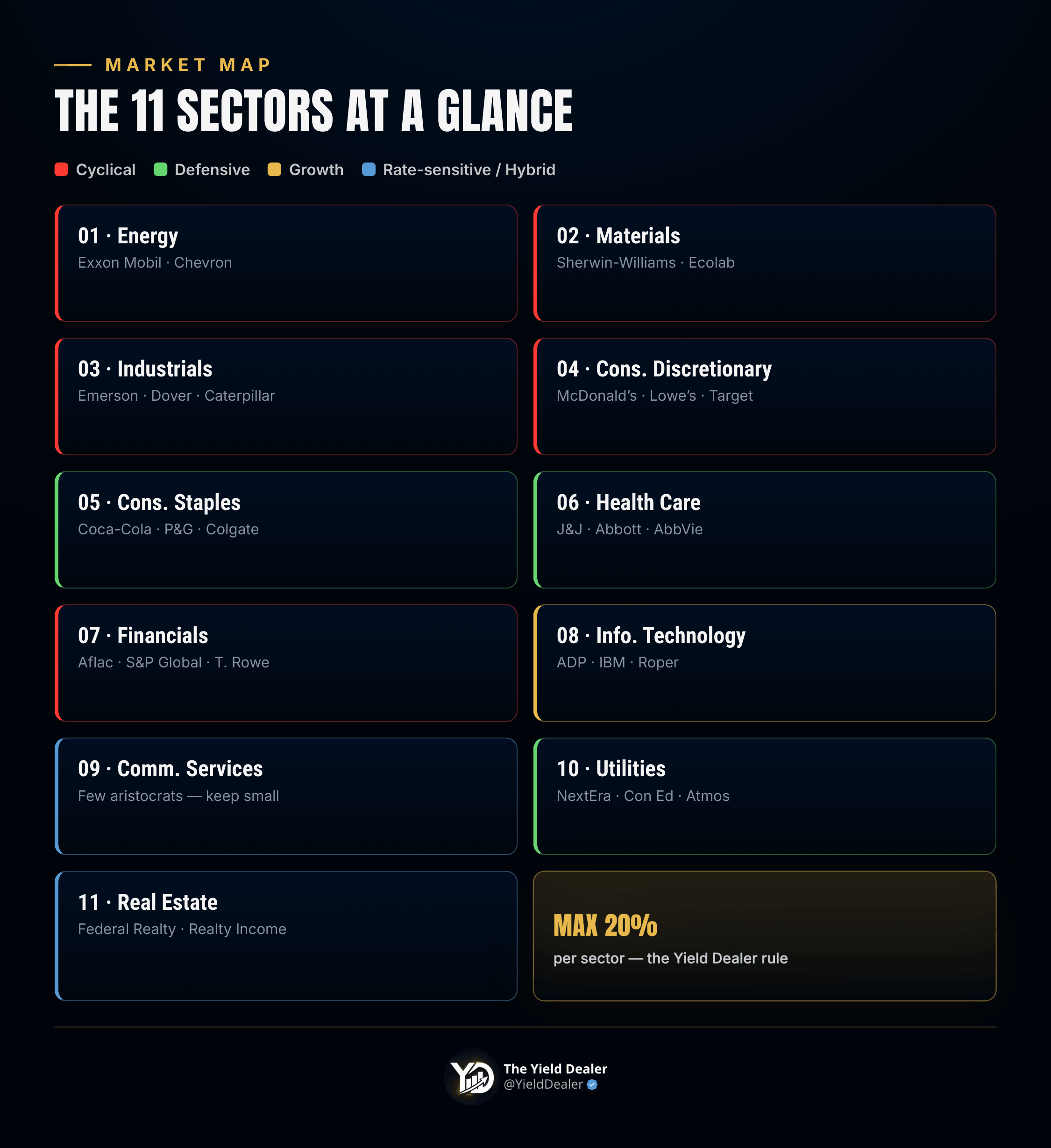
1. Energy ⛽️
The fuel of the economy — companies that explore for, produce, refine, and transport oil and gas.
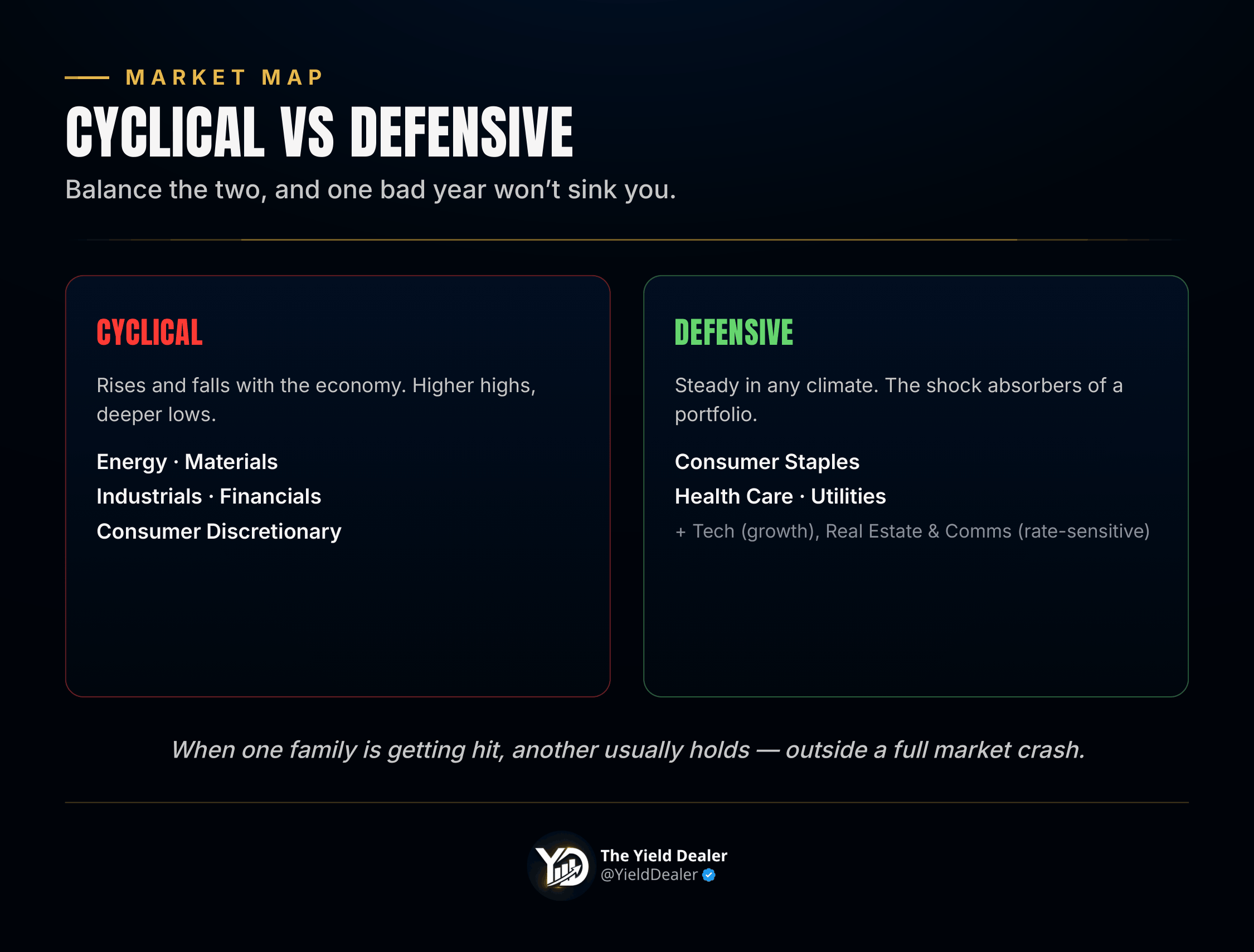
Profile: Highly cyclical. Profits track the price of crude.
Aristocrats: Exxon Mobil, Chevron.

2. Materials 📦
The suppliers of raw inputs — the elementary building blocks other industries use: metals, chemicals, packaging, coatings.
Profile: Cyclical. When the economy slows, less gets built, so fewer materials get bought.
Kings & Aristocrats: Sherwin-Williams, Air Products, Ecolab, Nucor.

3. Industrials 🏭
A vast sector — from building aircraft to waste management, machinery, railroads, and logistics.
Profile: Cyclical. These firms sign big contracts tied to the health of the global economy.
Kings & Aristocrats: Stanley Black & Decker, Emerson Electric, Dover, Illinois Tool Works, Caterpillar.

4. Consumer Discretionary 🍟
The “non-essential” goods and services people buy when they have money and confidence: restaurants, autos, apparel, hotels, leisure.
Profile: Cyclical. Often the first spending households cut in a downturn.
Kings & Aristocrats: McDonald’s, Lowe’s, Genuine Parts, Target.

5. Consumer Staples 🛒
The opposite — products people can’t do without, even in a recession: food, beverages, household and personal-care goods.
Profile: Defensive. Revenue is stable because people keep eating and cleaning.
Kings: Coca-Cola, Procter & Gamble, Colgate-Palmolive, PepsiCo.

6. Health Care 🏥
Pharma labs, biotech, medical-device makers, and hospital operators.
Profile: Defensive. Health is a priority regardless of the economy.
Kings & Aristocrats: Johnson & Johnson, Abbott Laboratories, AbbVie, Becton Dickinson.

7. Financials 📊
The engine of money — banks, insurers, asset managers, and payment networks.
Profile: Cyclical. Generally benefits from higher interest rates and a strong economy.
Kings & Aristocrats: Franklin Templeton, Aflac, Cincinnati Financial, S&P Global, T. Rowe Price.

8. Information Technology 💻
The star sector of recent decades — hardware makers (chips, computers) and software developers.
Profile: Growth. Often volatile; it drives the performance of US indexes. Few names here are old enough to be Aristocrats — dividends are young in tech — but a handful qualify.
Aristocrats: Automatic Data Processing (ADP), IBM, Roper Technologies.

9. Communication Services 📡
Born from merging telecom and media — wireless carriers, social networks, streaming, and video games.
Profile: Hybrid. Telecom is defensive (subscriptions); media/advertising is more cyclical.
Verizon, AT&T, Comcast.

10. Utilities 💧
The providers of water, gas, and electricity — highly predictable, regulated revenue.
Profile: Ultra-defensive. Classic “sleep-well-at-night” stocks: big dividends, slow growth.
Kings & Aristocrats: NextEra Energy, Consolidated Edison, Atmos Energy, American States Water, H2O America.

11. Real Estate 🏢
The REITs (Real Estate Investment Trusts) that own and manage property portfolios — offices, malls, warehouses, residential.
Profile: Rate-sensitive. Pays strong dividends (rents) but suffers when borrowing rates rise.
King & Aristocrats: Federal Realty (the only REIT Dividend King), Essex Property Trust, plus the famous monthly payer Realty Income.

The Yield Dealer rule: never more than 20% in one sector
Knowing the 11 sectors is the key to diversification — and diversification is what keeps one bad year from sinking your portfolio.
Here’s the discipline we follow at The Yield Dealer:
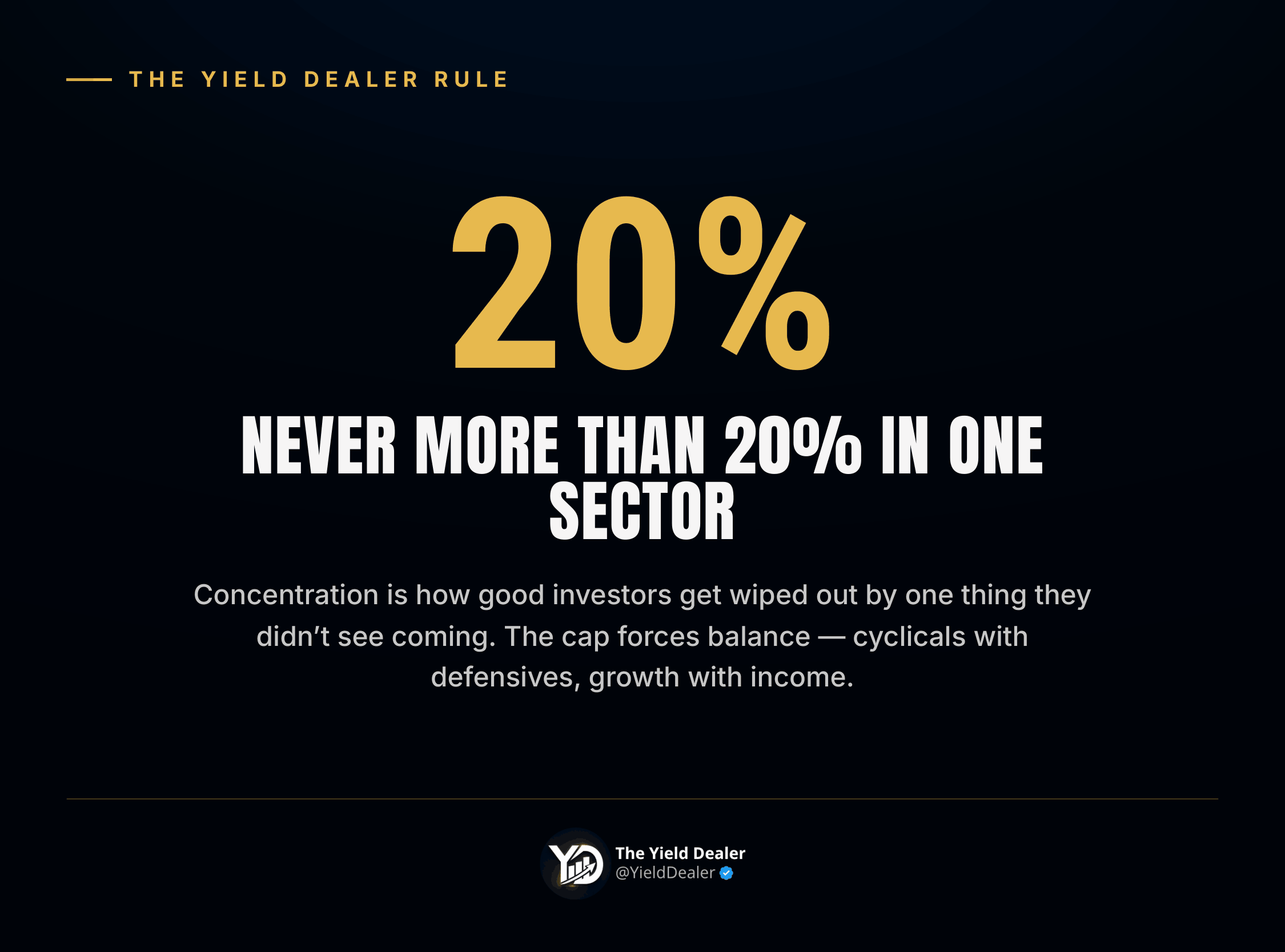
Never put more than 20% of your portfolio in a single sector.
Why it matters: if you own only tech, you’re 100% exposed to growth — and to every tech selloff. Load up only on high-yield utilities and REITs, and a single rate shock hits your whole book at once. Concentration is how good investors get wiped out by one thing they didn’t see coming.
The 20% cap forces balance. Pair cyclicals (energy, industrials, financials) with defensives (staples, health care, utilities). Mix growth (tech) with income (REITs, utilities). When one family is getting hit, another is usually holding up — because outside of a full-blown market crash, where everything falls together, the sectors rarely move as one.
A good investor is like a chef, they know how to balance ingredients from every family to build a menu that holds up in any season.


Want to get The Yield Dealer’s Newsletter in your inbox? Join other readers here.
Want short ideas on living and working on your own terms? Follow me on X/Twitter and Instagram.