
Beyond Nvidia: 6 Stocks Powering the AI Infrastructure Boom
The AI trade is shifting from chips to the entire supply chain and the valuations are finally reasonable.

For two years, one name owned the AI story: Nvidia. But the next phase of the boom — the one that will define the rest of 2026 — isn’t about a single chip. It’s about the entire ecosystem required to make AI actually run: high-speed networking, custom silicon, foundry capacity, and the physical data centers themselves.
This is one of the largest infrastructure projects in history. And right now, several of the highest-quality names in that supply chain have pulled back into attractive territory — many trading at PEG ratios below 1.0, meaning their growth may be cheaper than the market realizes.
Here are six companies positioned to dominate the AI supply chain.
1. The Investment Thesis: It’s the Infrastructure, Not Just the Chips
Every new AI model demands four things in equal measure:
Networking — so thousands of GPUs can talk to each other without sitting idle.
Custom silicon — chips tailored to a hyperscaler’s specific workload.
Advanced manufacturing — the foundry capacity to build ever-more-complex hardware.
Physical infrastructure — the land, power, and utilities for massive data-center clusters.
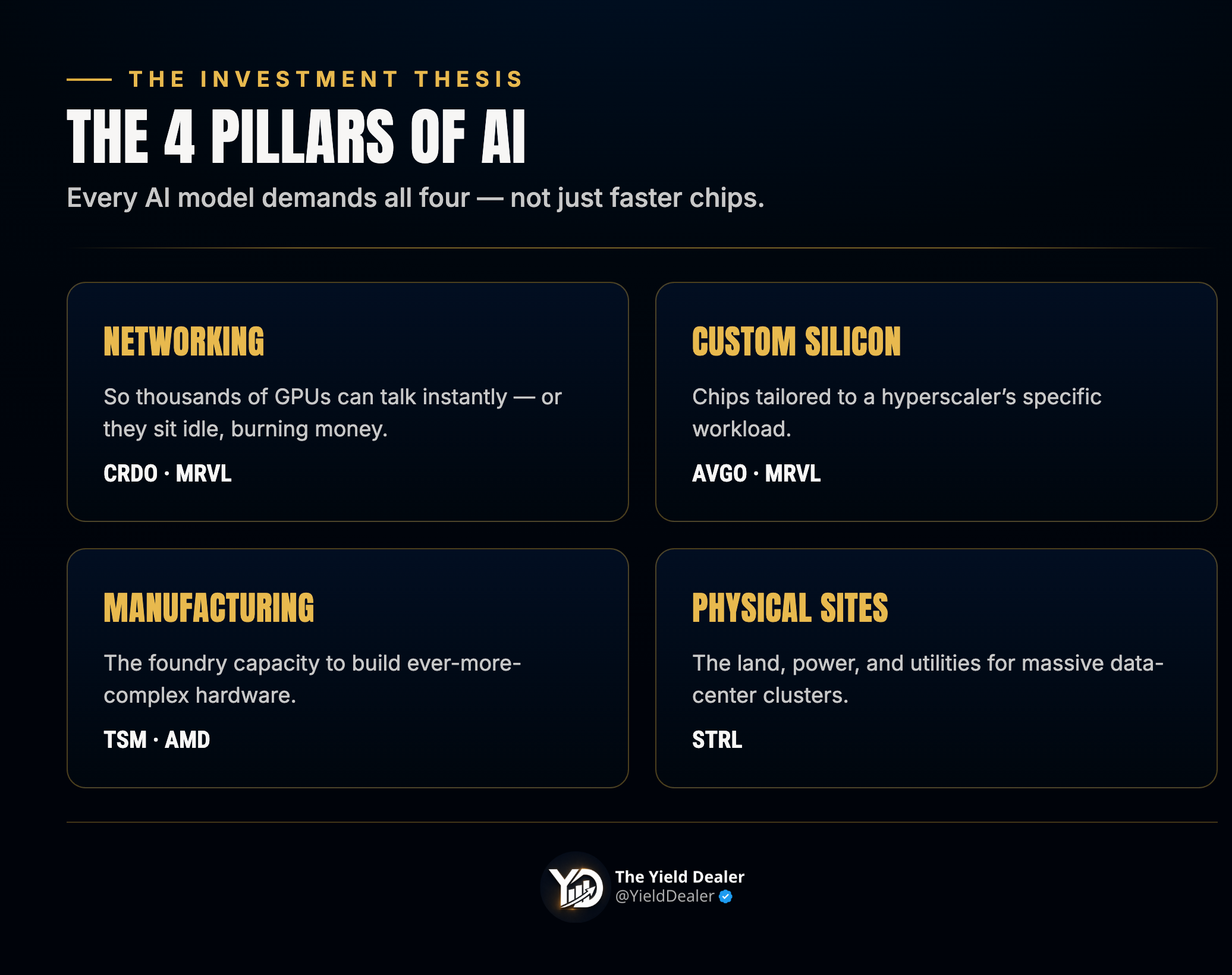
Investors who own the whole chain — not just compute — are positioned to capture the durable growth. Let’s go through the six leaders by role.
2. High-Speed Connectivity: Credo & Marvell
Credo Technology (CRDO)
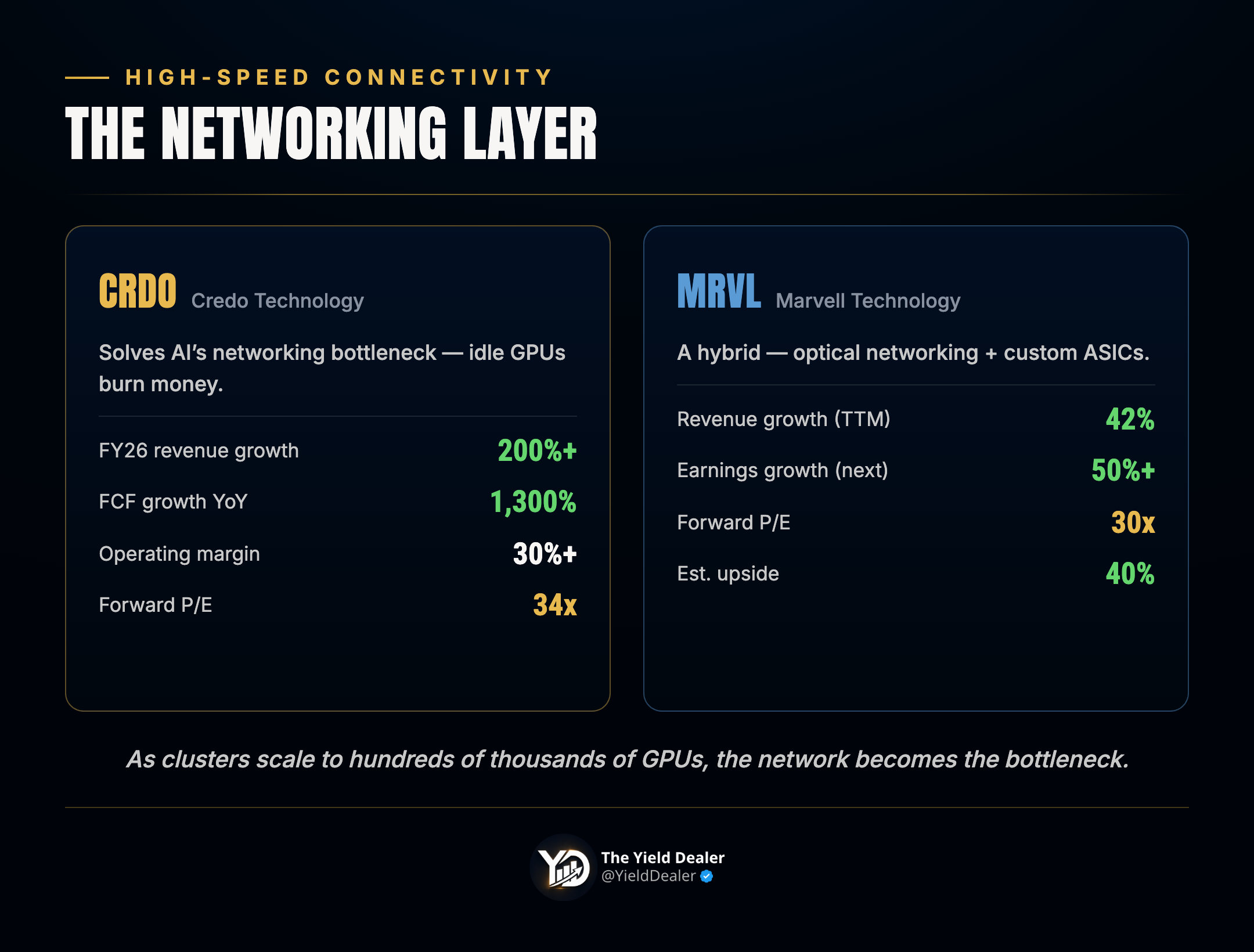
Credo solves one of AI’s biggest bottlenecks: networking. As clusters scale to thousands of GPUs, if the network lags, those expensive chips sit idle — burning money.
Revenue up 200%+ in fiscal 2026; ~85% growth projected for the next 12 months.
Operating margins above 30%; free cash flow up 1,300% year-over-year.
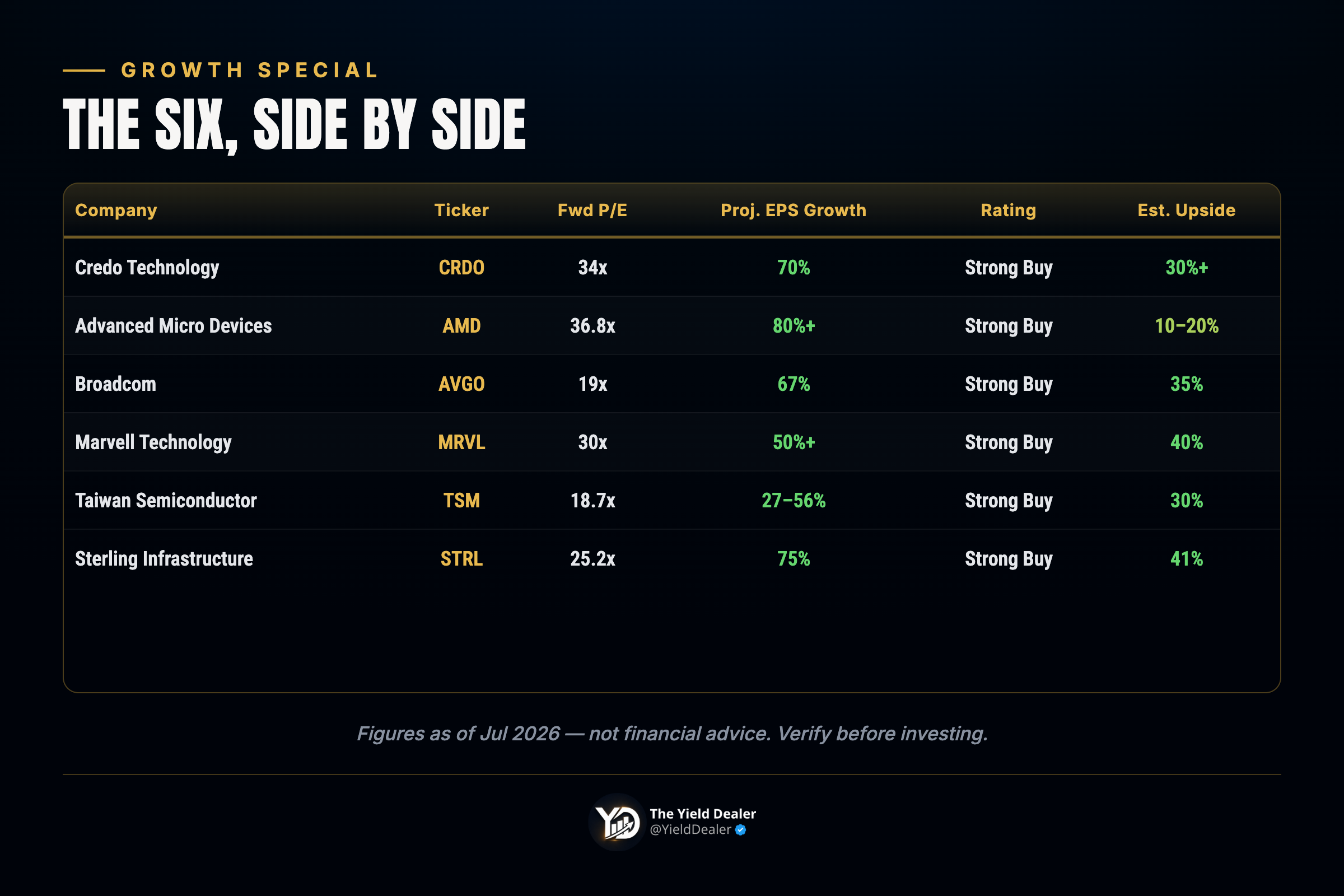
Forward P/E of 34x (below its 52x average), with ~70% expected earnings growth.
Marvell Technology (MRVL)
Marvell is a hybrid — networking + custom silicon. It supplies optical connectivity and switching alongside the custom ASICs that next-gen AI infrastructure depends on.
Revenue up 42% over the past year; earnings growth accelerating toward 50% next year.
As clusters scale to hundreds of thousands of GPUs, its role only grows more critical.
3. Compute & Custom Silicon: AMD & Broadcom
Advanced Micro Devices (AMD)
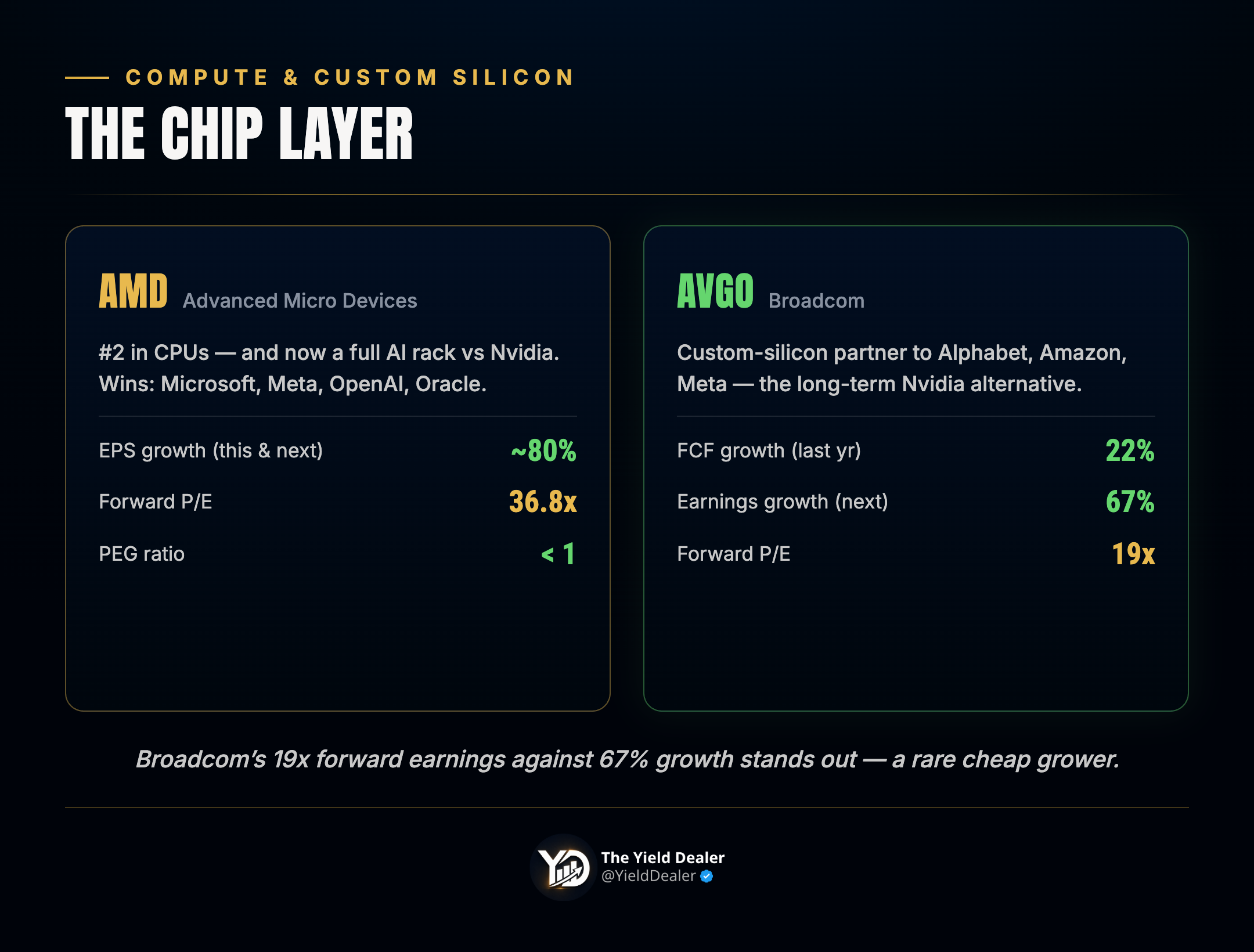
AMD competes with Nvidia in GPUs, but it’s the clear #2 in CPUs — required to work alongside GPUs in every AI rack. It just announced a full AI rack to take Nvidia head-on, and has already secured Microsoft, Meta, OpenAI, and Oracle.
EPS growth ~80% projected this year and next.
Forward P/E of 36.8x — a PEG ratio below 1.
Broadcom (AVGO)
Broadcom is the custom-silicon partner to the hyperscalers — Alphabet, Amazon, Meta — letting them design proprietary chips instead of relying on generic Nvidia hardware. A long-term structural play.
22% free cash flow growth last year; among the highest operational quality in the S&P 500.
Trades at just 19x forward earnings despite ~67% projected earnings growth.
4. Manufacturing & Physical Buildout: TSMC & Sterling
Taiwan Semiconductor (TSM)
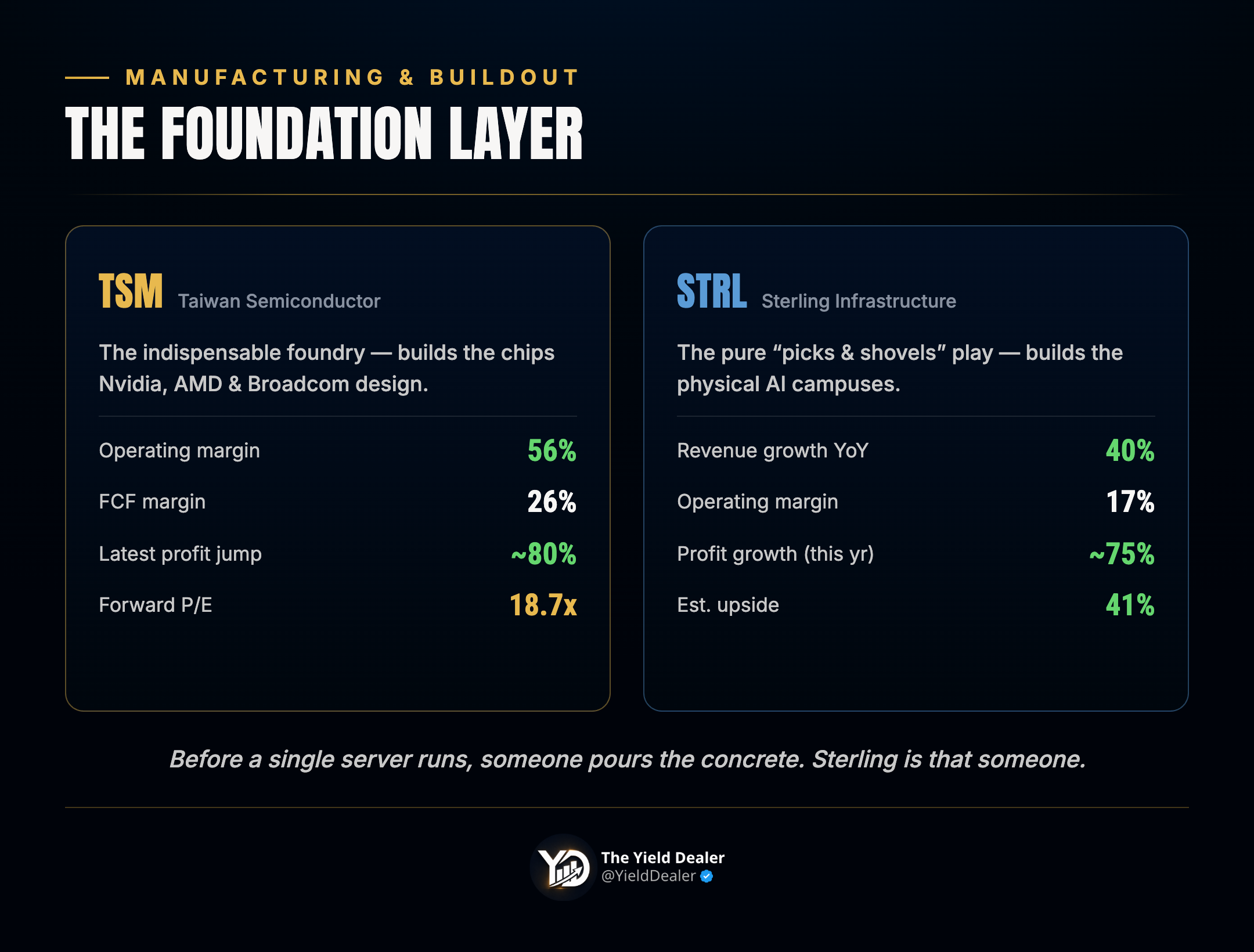
The indispensable manufacturer of the AI era — it builds the chips designed by Nvidia, AMD, Broadcom, and nearly every custom AI developer.
Operating margin of 56%; free cash flow margin of 26%.
Profits jumped nearly 80% in the latest report — making the “27% next year” estimate look conservative.
Sterling Infrastructure (STRL)
The pure “picks and shovels” play. Before a single server goes in, someone has to do the civil engineering — sites, roads, utilities, concrete. Sterling builds the “AI campuses.”
Revenue up 40% year-over-year; 17% operating margin; ~75% projected profit growth this year.
5. The Numbers Side by Side
Bottom Line
The AI trade is broadening. The biggest opportunities for the rest of 2026 aren’t in the obvious mega-cap — they’re in the companies quietly building the plumbing: networking, custom silicon, manufacturing, and the physical sites that let AI scale.
All six pair strong growth with valuations that suggest real upside relative to their earnings trajectory. As always: this isn’t a buy list — it’s a starting point. Do the work, size positions sensibly, and remember our rule — never more than 20% of your portfolio in one sector, and AI infrastructure is one sector.


Want to get The Yield Dealer’s Newsletter in your inbox? Join other readers here.
Want short ideas on living and working on your own terms? Follow me on X/Twitter and Instagram.