


Some of the best businesses in the market are not the ones you hear about every day.
They don’t dominate CNBC.
They don’t have thousands of investors debating their next earnings target on X.
And they certainly aren’t considered “exciting” stocks.
Broadridge Financial Solutions is one of those companies.
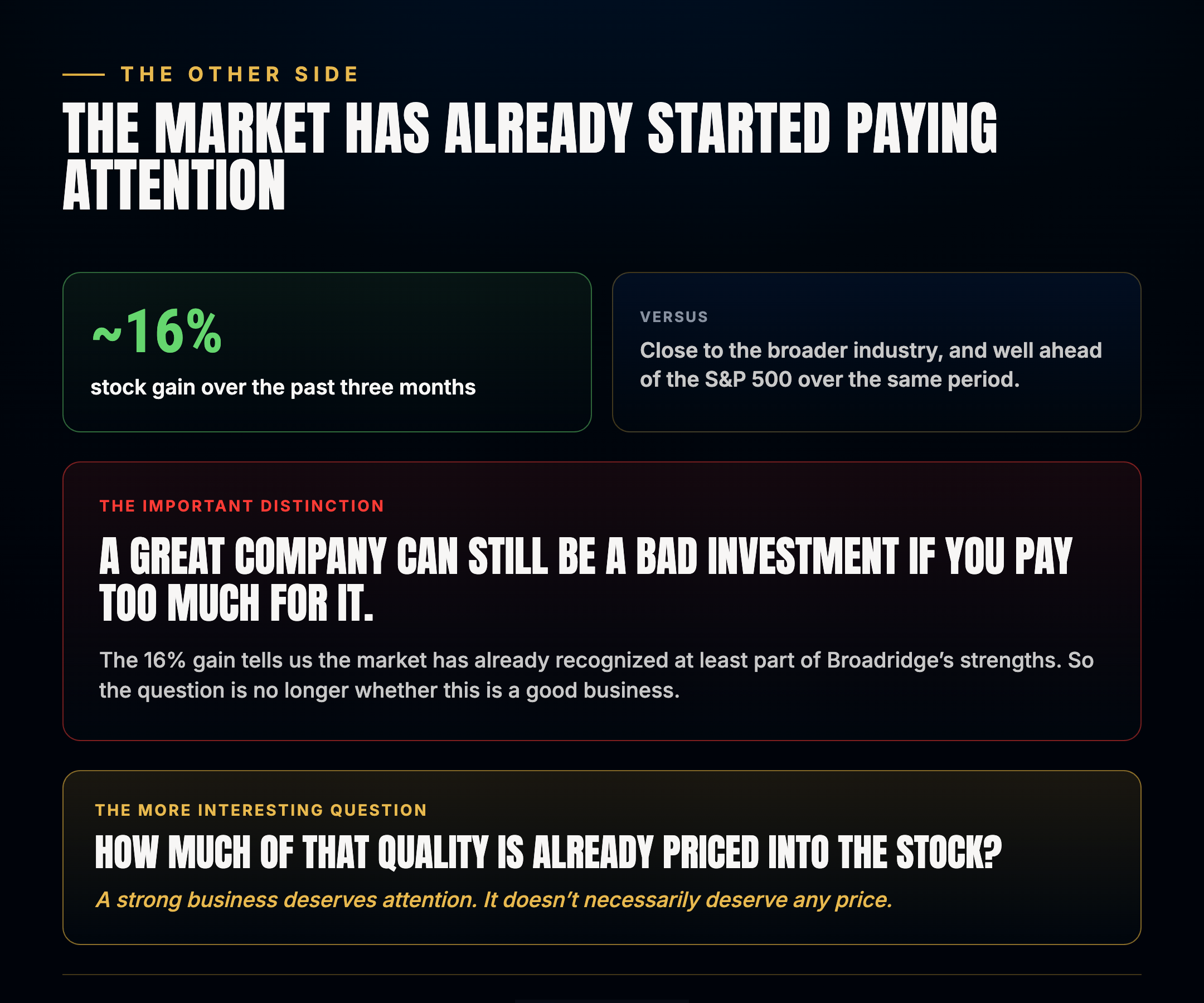
The stock has gained roughly 16% over the past three months, putting it close to the broader industry’s performance and well ahead of the S&P 500 over the same period.
At first glance, that might not sound particularly impressive.
But the more I look at Broadridge, the more I understand why investors have been willing to pay a higher price for the business.
Because the real story isn’t the 16% stock gain.
It’s what sits underneath it.
Broadridge operates in a part of the financial system that most investors rarely think about, providing technology and infrastructure that financial institutions rely on to process transactions, communicate with investors and manage critical operations.
And that creates something I really like in a business:
recurring revenue that doesn’t depend entirely on market sentiment.
Subscribe for free to receive independent market analysis and practical investing insights.
Broadridge Isn’t a Typical Financial Stock
When you hear “financial company,” you probably think about banks, insurers or asset managers.
Broadridge is different.
Its business is deeply embedded in the infrastructure of financial markets.
The company provides technology and services to financial institutions, helping them handle everything from investor communications to securities processing and other back-office functions.
That may not sound exciting.
But boring can be extremely profitable.
Once a financial institution has integrated critical infrastructure into its operations, replacing it isn’t as simple as switching software providers.
There are costs.
There are risks.
There are regulatory requirements.
And, most importantly, there is very little incentive to disrupt something that already works.
That helps explain one of the numbers that caught my attention:
98% client retention.
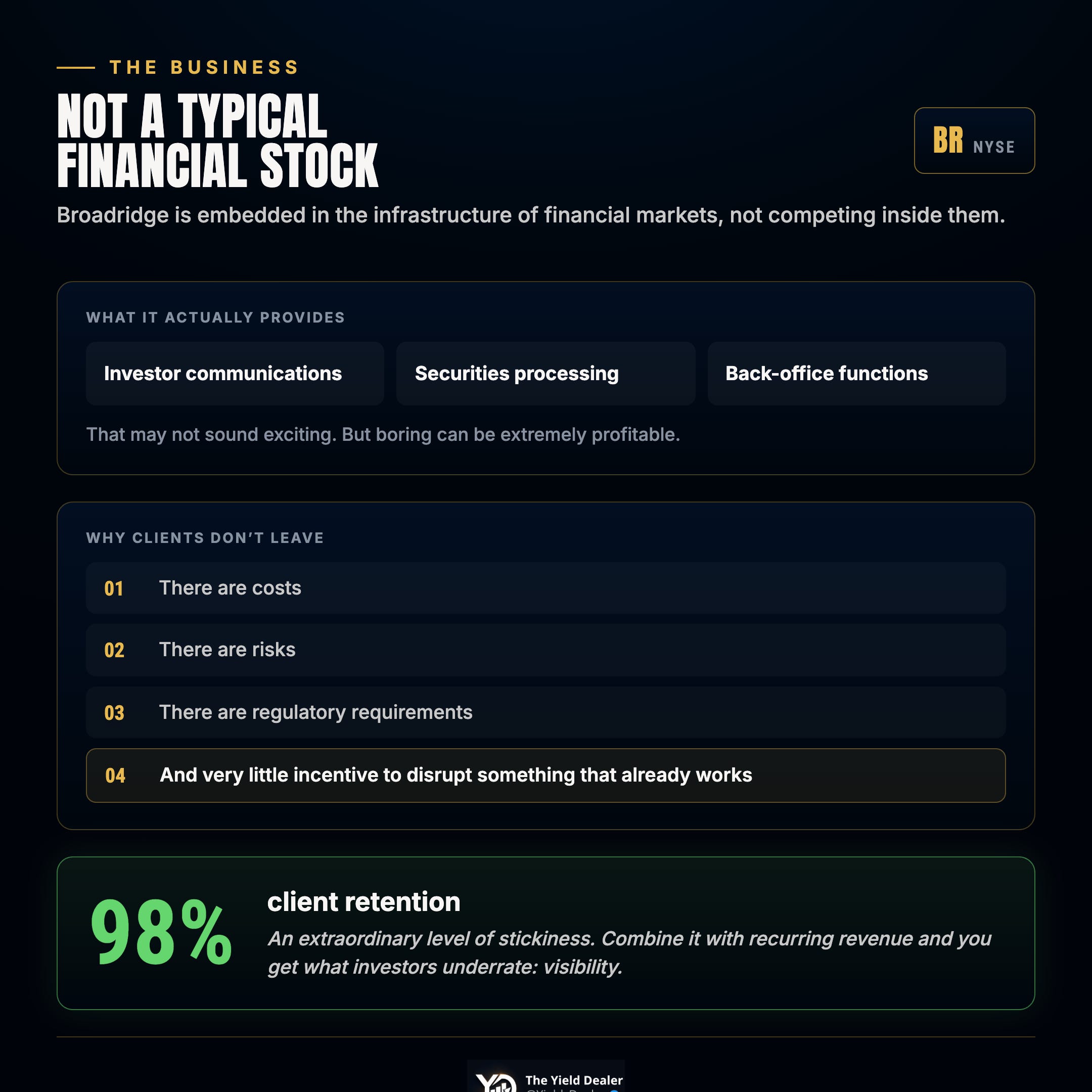
That’s an extraordinary level of stickiness.
And when you combine that retention with recurring revenue, you get something investors don’t always appreciate until they see it in the numbers:
visibility.
The Part I Like Most: Recurring Revenue
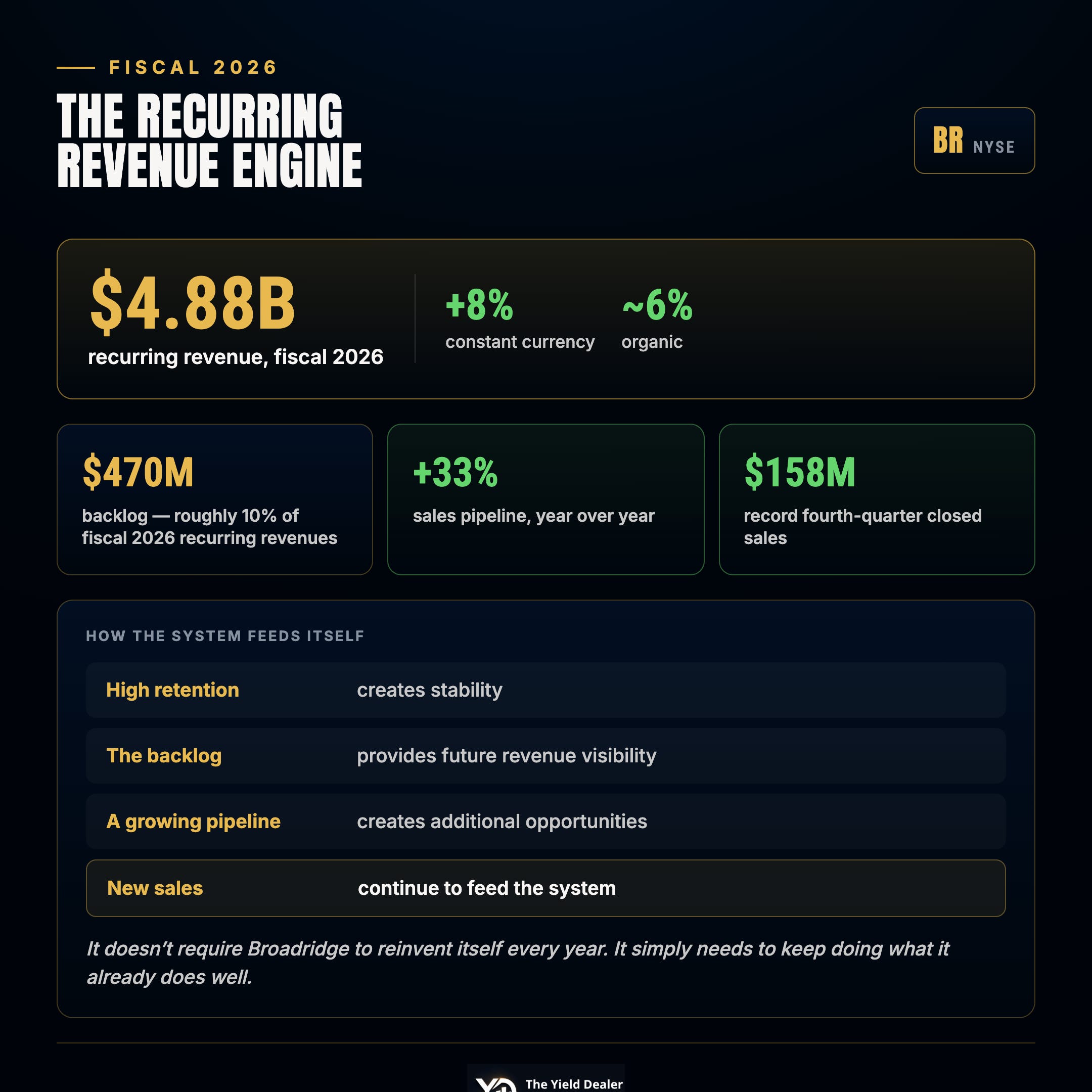
Broadridge generated $4.88 billion in recurring revenue during fiscal 2026, up 8% on a constant-currency basis.
Organic growth accounted for roughly 6%.
Those numbers matter because recurring revenue gives management a much clearer view of what the business could look like several quarters from now.
And Broadridge isn’t simply relying on its existing customers.
The company ended the period with a $470 million backlog, representing roughly 10% of fiscal 2026 recurring revenues.
Its sales pipeline also increased by more than one-third year over year.
Then came another important number.
Record fourth-quarter closed sales reached $158 million.
Put all of that together and the picture becomes fairly straightforward.
High customer retention creates stability.
The backlog provides future revenue visibility.
A growing pipeline creates additional opportunities.
And new sales continue to feed the system.
That is the kind of business model I find attractive because it doesn’t require Broadridge to reinvent itself every year.
It simply needs to keep doing what it already does well.
And Management Isn’t Promising Crazy Growth
This is another reason I find Broadridge interesting.
Management isn’t promising that revenue will suddenly double.
It doesn’t need to.
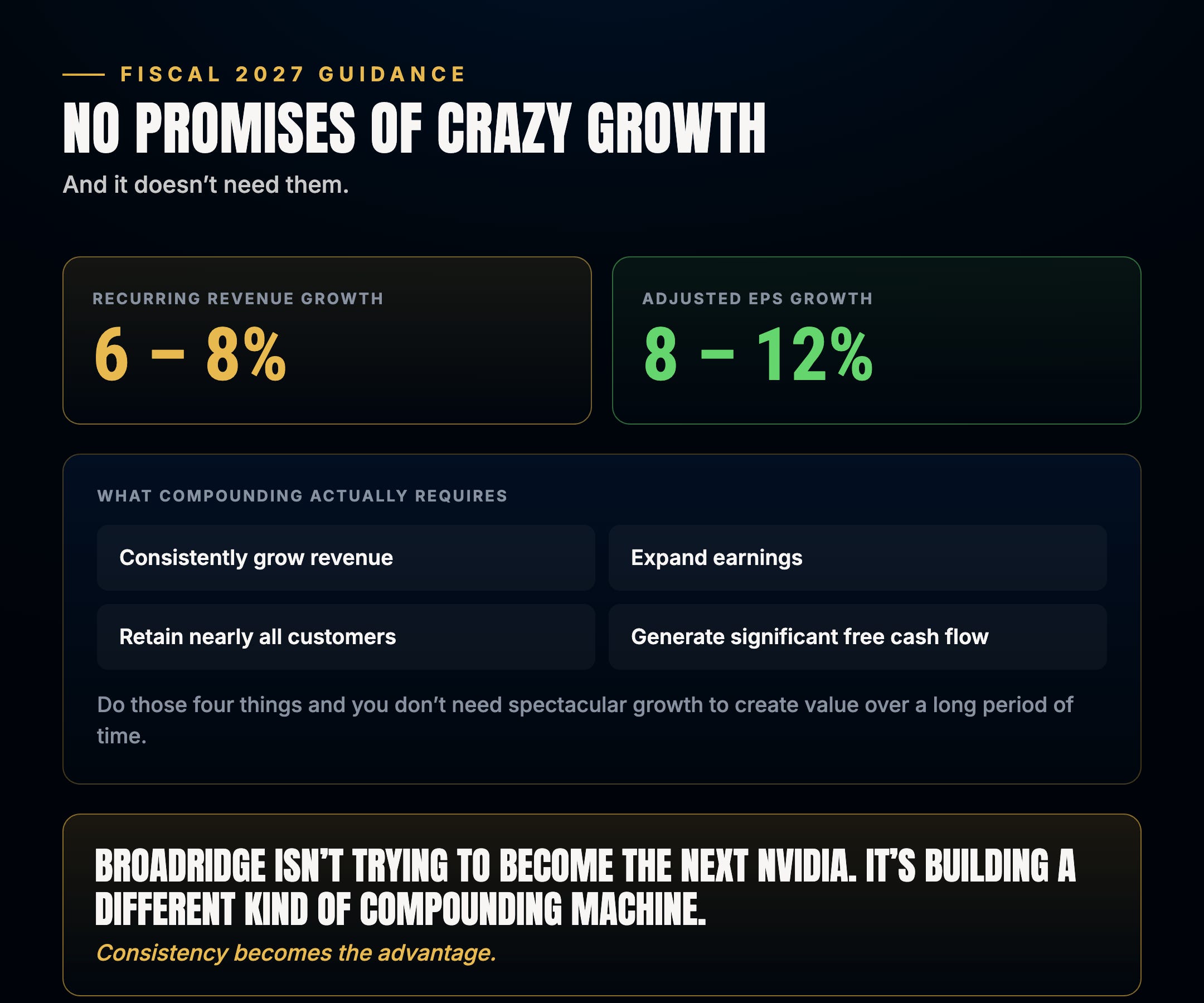
For fiscal 2027, the company expects recurring revenue growth of approximately 6-8%, alongside adjusted EPS growth of 8-12%.
At first glance, those numbers might look relatively modest compared with some of the technology companies currently attracting investors.
But that’s exactly the point.
Broadridge isn’t trying to become the next Nvidia.
It’s building a different kind of compounding machine.
If a company can consistently grow revenue, expand earnings, retain nearly all of its customers and generate significant free cash flow, it doesn’t need spectacular growth to create value over a long period of time.
Consistency becomes the advantage.
Then There’s the Margin Story
Revenue growth is only part of the equation.
The next question is whether Broadridge can turn that growth into more earnings.
So far, the answer looks encouraging.
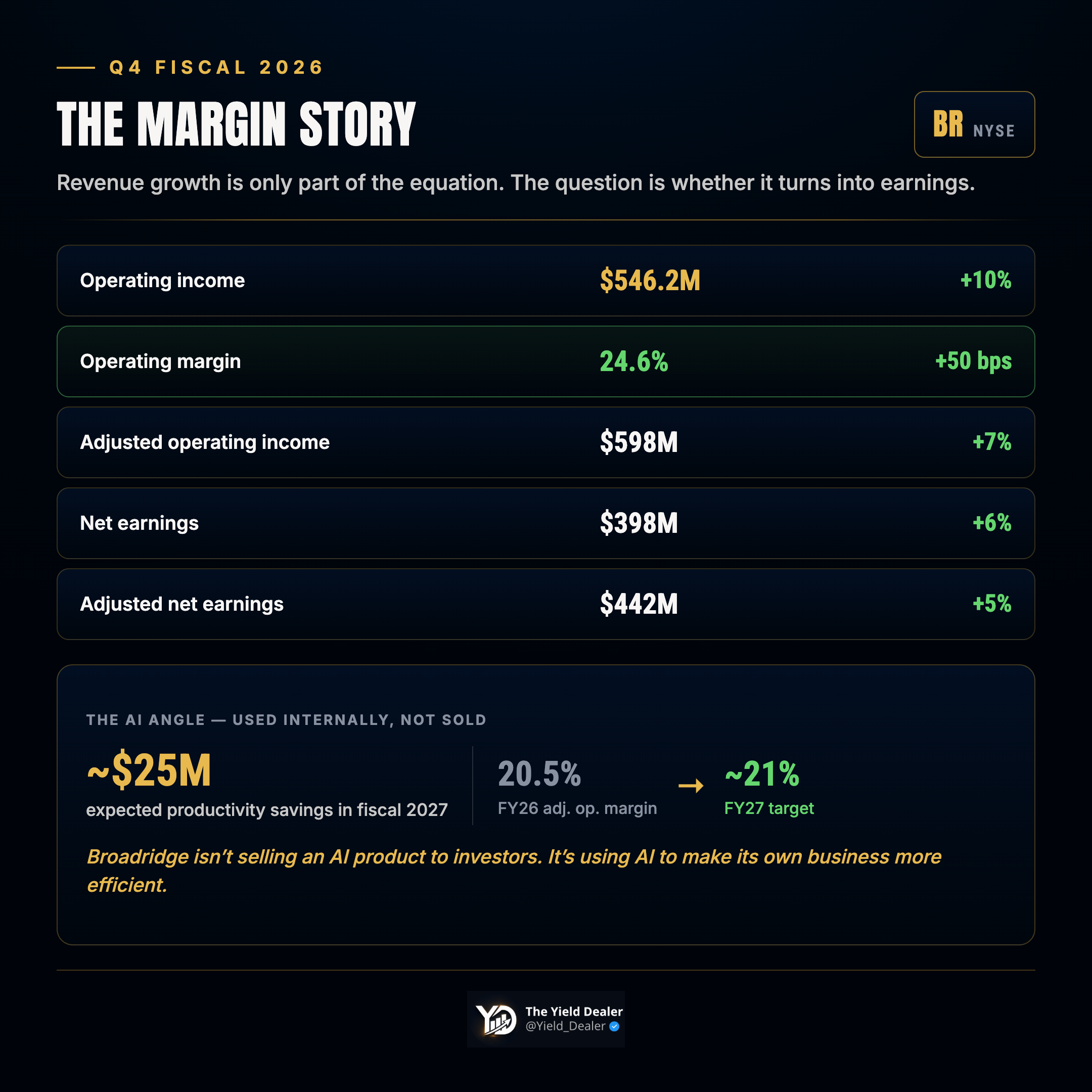
Operating income increased 10% to $546.2 million in the fourth quarter of fiscal 2026.
Operating margin expanded by 50 basis points to 24.6%.
Adjusted operating income increased 7% to $598 million, while net earnings rose 6% to $398 million.
Adjusted net earnings increased 5% to $442 million.
None of these numbers scream hypergrowth.
And I don’t think they need to.
What I want to see from a business like Broadridge is operating leverage.
If revenue keeps growing while the company becomes more efficient, a larger percentage of each additional dollar of revenue can eventually flow through to earnings.
Management also expects artificial intelligence to contribute approximately $25 million in productivity savings during fiscal 2027.
That could help fund further investments while supporting adjusted operating margin expansion from roughly 20.5% in fiscal 2026 toward about 21%.
AI is therefore playing an interesting role here.
Broadridge isn’t selling an AI product to investors.
It’s using AI to make its own business more efficient.
And honestly?
I prefer that kind of AI story sometimes.
Cash Flow Is Where Broadridge Gets Really Interesting
There is another part of the story that I don’t think investors should overlook.
Cash flow.
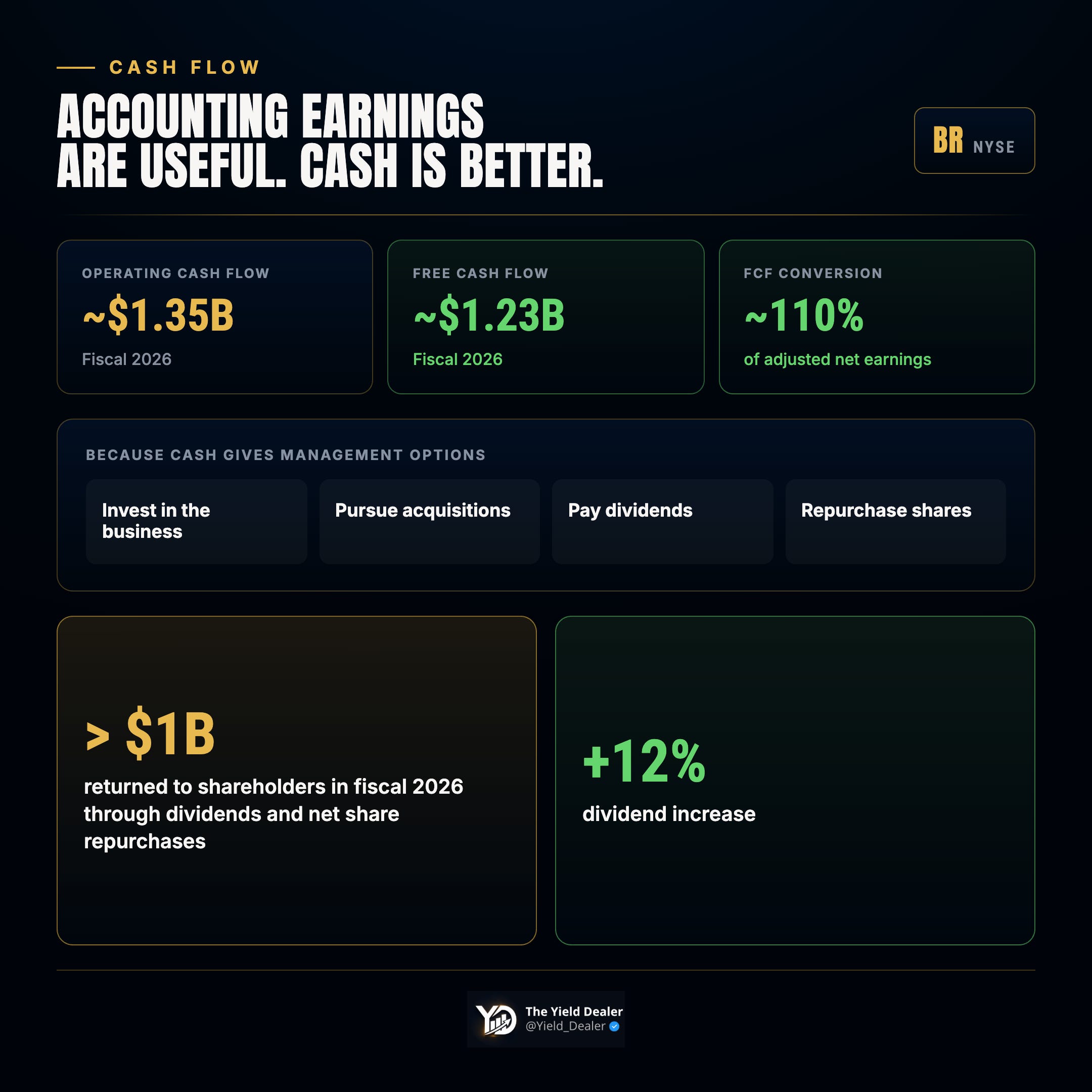
Broadridge generated approximately $1.35 billion in operating cash flow and $1.23 billion in free cash flow during fiscal 2026.
That’s roughly 110% free-cash-flow conversion relative to adjusted net earnings.
For me, this is one of the most important characteristics of the business.
Accounting earnings are useful.
Cash is better.
Because cash gives management options.
Broadridge can invest in the business.
It can pursue acquisitions.
It can pay dividends.
And it can repurchase shares.
During fiscal 2026, the company returned more than $1 billion to shareholders through dividends and net share repurchases.
The dividend was also increased by 12%.
This is where Broadridge starts to fit particularly well into the type of companies I like to follow at The Yield Dealer.
I’m not necessarily looking for the fastest-growing business in the market.
I’m looking for businesses that can compound.
Strong recurring revenue.
High customer retention.
Growing earnings.
Large free cash flow.
And a management team that can return some of that cash to shareholders.
That’s a pretty powerful combination.
The Market Has Already Started Paying Attention
Of course, none of this means the stock is automatically cheap.
That’s an important distinction.
A great company can still be a bad investment if you pay too much for it.
The recent 16% gain tells us that the market has already recognized at least part of Broadridge’s strengths.
The question now becomes less about whether Broadridge is a good business.
I think the numbers make a strong case that it is.
The more interesting question is:
How much of that quality is already priced into the stock?
That’s where valuation becomes important.
And it’s also where I think investors need to resist the temptation to chase performance simply because a stock has been moving higher.
A strong business deserves attention.
It doesn’t necessarily deserve any price.
Why Broadridge Caught My Attention
What I find particularly interesting about Broadridge is the combination of characteristics.
It’s not just growing.
It’s growing with recurring revenue.
It’s not just profitable.
It’s generating substantial free cash flow.
It’s not just acquiring customers.
It’s retaining approximately 98% of them.
It’s not just generating cash.
It’s returning more than $1 billion to shareholders while continuing to invest in the business.
And management isn’t relying on one giant bet to justify the future.
The business is being built through hundreds of smaller improvements.
More clients.
More recurring revenue.
More efficiency.
More cash flow.
More capital returned to shareholders.
That’s not a particularly exciting story.
But over a decade?
It can become a very powerful one.
The Bigger Picture
This is probably the biggest lesson I take away from Broadridge.
Investors often spend most of their time looking for the next big thing.
The next AI winner.
The next semiconductor leader.
The next company that can grow revenue 50% a year.
But there is another way to build wealth.
You can own companies that quietly become more valuable year after year because their customers keep coming back, their revenue keeps recurring, their margins gradually improve and their cash flows keep growing.
Broadridge fits that description remarkably well.
The company isn’t going to generate the same headlines as Nvidia.
It probably shouldn’t.
It’s playing a completely different game.
And that’s exactly why I find it interesting.
In a market obsessed with what’s next, there is something refreshing about a company whose competitive advantage comes from being deeply embedded in what already exists.
Wall Street needs its infrastructure.
And Broadridge is one of the companies helping keep that infrastructure running.
The stock has already moved higher.
But the more important question isn’t where it has been over the last three months.
It’s whether the underlying business can continue compounding from here.
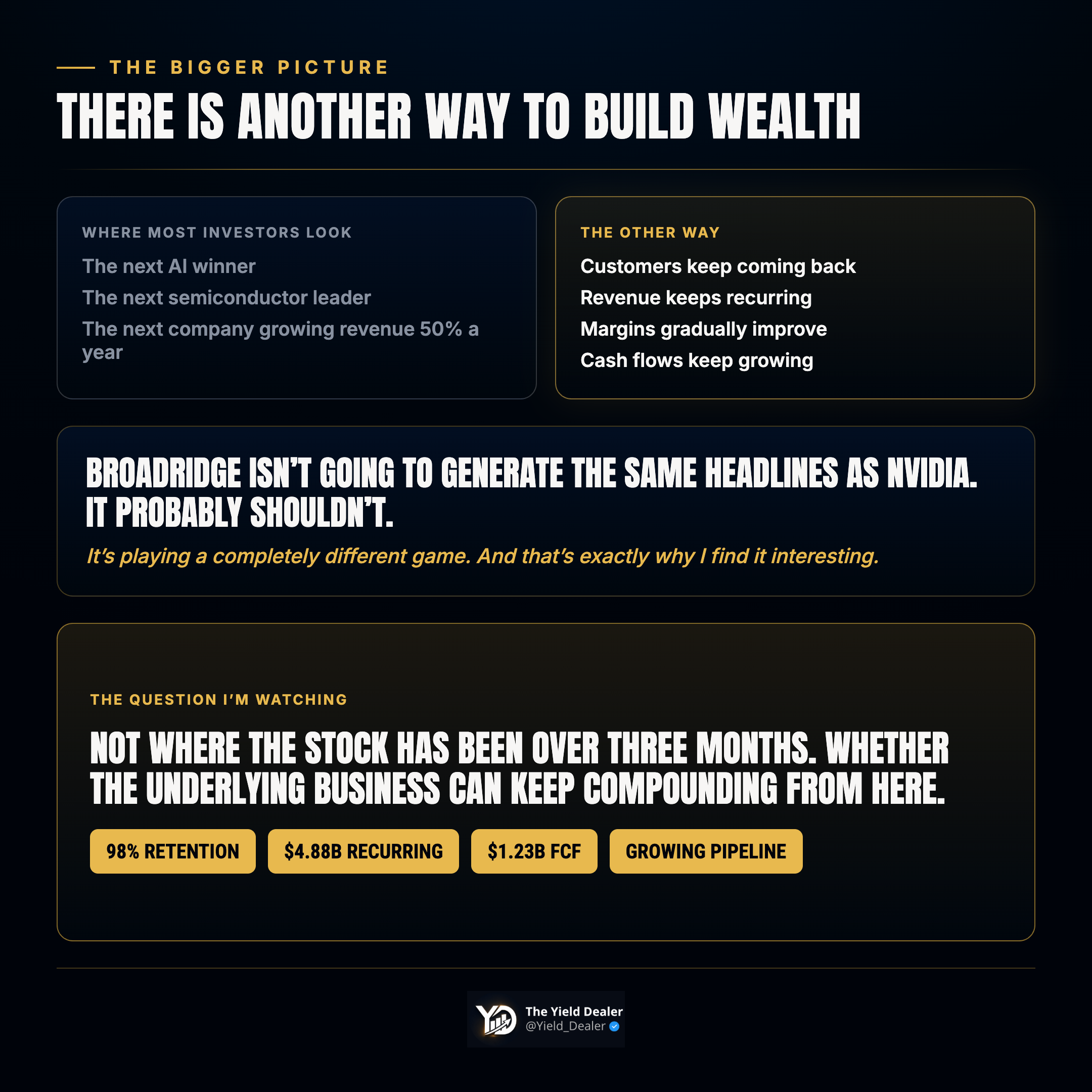
For a company with 98% client retention, billions in recurring revenue, strong free cash flow and a growing pipeline, that’s the question I’m watching.


Want to get The Yield Dealer’s Newsletter in your inbox? Join other readers here.
Want short ideas on living and working on your own terms? Follow me on X/Twitter and Instagram.