

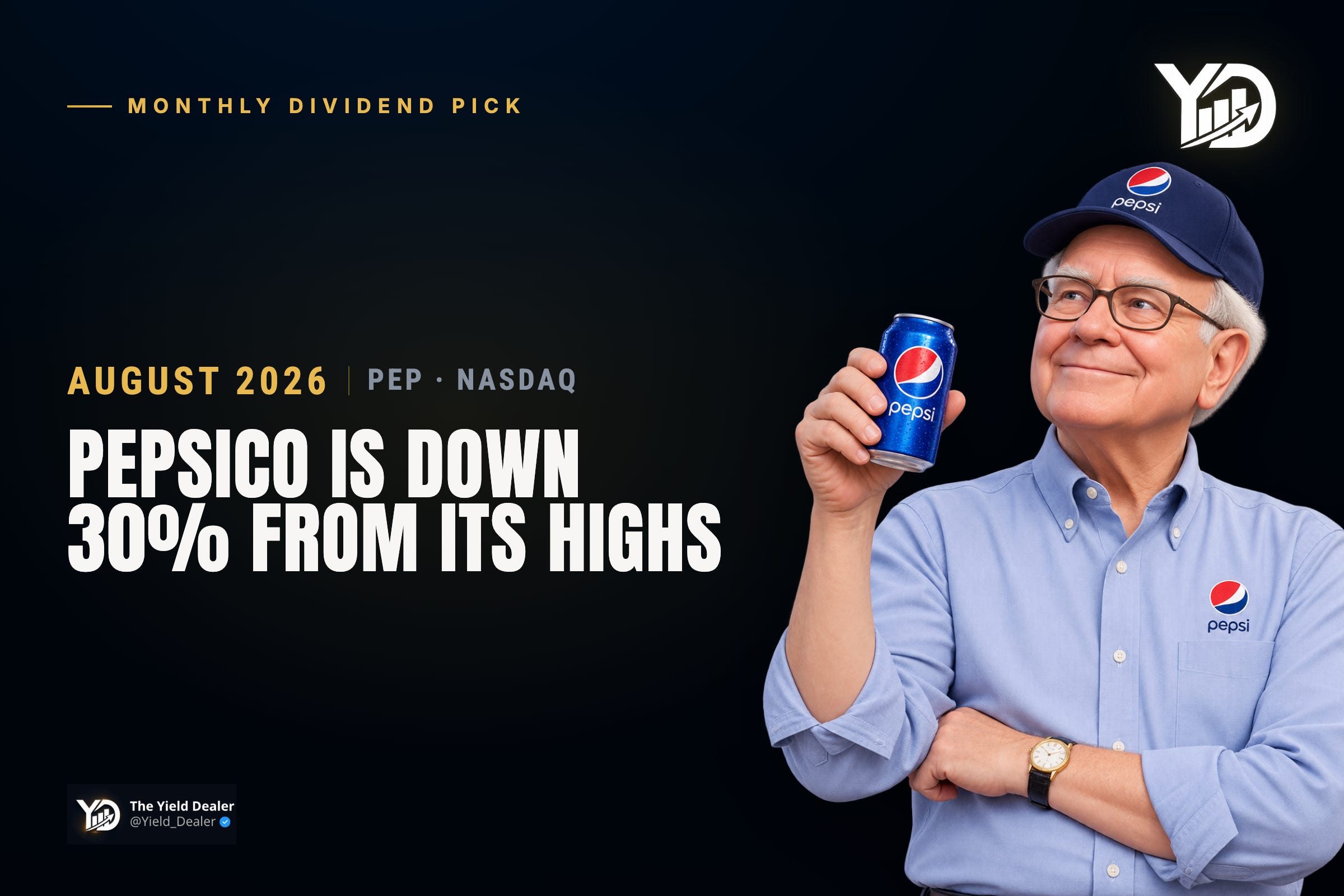
Every month, I pick one dividend stock and buy it.
No timing games.
No macro predictions.
No chasing whatever ticker is trending on X this week.
The goal is simple: build a portfolio of businesses that can survive recessions, grow cash flow, raise dividends, and quietly compound for years.
This month, I am not making a new pick.
I am adding to an existing one.
And honestly? I am doing it with more conviction than the first time.
The stock is PepsiCo.
Ticker: PEP.
A company that has raised its dividend for 54 consecutive years.
Not during easy markets only.
Not when the economy was booming and everyone looked smart.
Not when consumers were flush with cash and spending freely.
54 years.
54 raises.
Zero exceptions.
And right now, the stock is sitting near multi-year lows, trading around $142 — roughly 30% below its all-time highs — while the underlying business keeps growing revenue, growing earnings, and returning billions to shareholders.
That is the kind of setup I cannot ignore.
Subscribe for free to receive independent market analysis and practical investing insights.
⚡ Quick Thesis
Ticker: PEP (NASDAQ)
Business: Global snacks and beverages — Pepsi, Lay’s, Doritos, Gatorade, Cheetos, Quaker and 20+ others
Dividend streak: 54 consecutive years of increases (Dividend King)
Current yield: ~4.28% ($6.46 annualized)
Moat Wide: Brand portfolio, distribution scale, retail relationships, pricing power
Main risk: North America margin pressure + consumer pushback on pricing
Verdict: One of the most defensive businesses on earth, at the most attractive price in years. I’m adding.
The Business: Snacks, Beverages, and the Most Reliable Revenue Stream I Know
Let me tell you something about PepsiCo that most people get wrong.
When you say “Pepsi,” people think soda. They picture the blue can sitting next to a Coke at a barbecue, perpetually losing the cola wars.
That mental image is outdated — and it is costing investors who dismiss this stock too quickly.
59% of PepsiCo’s revenue comes from snacks. Not beverages. Snacks.
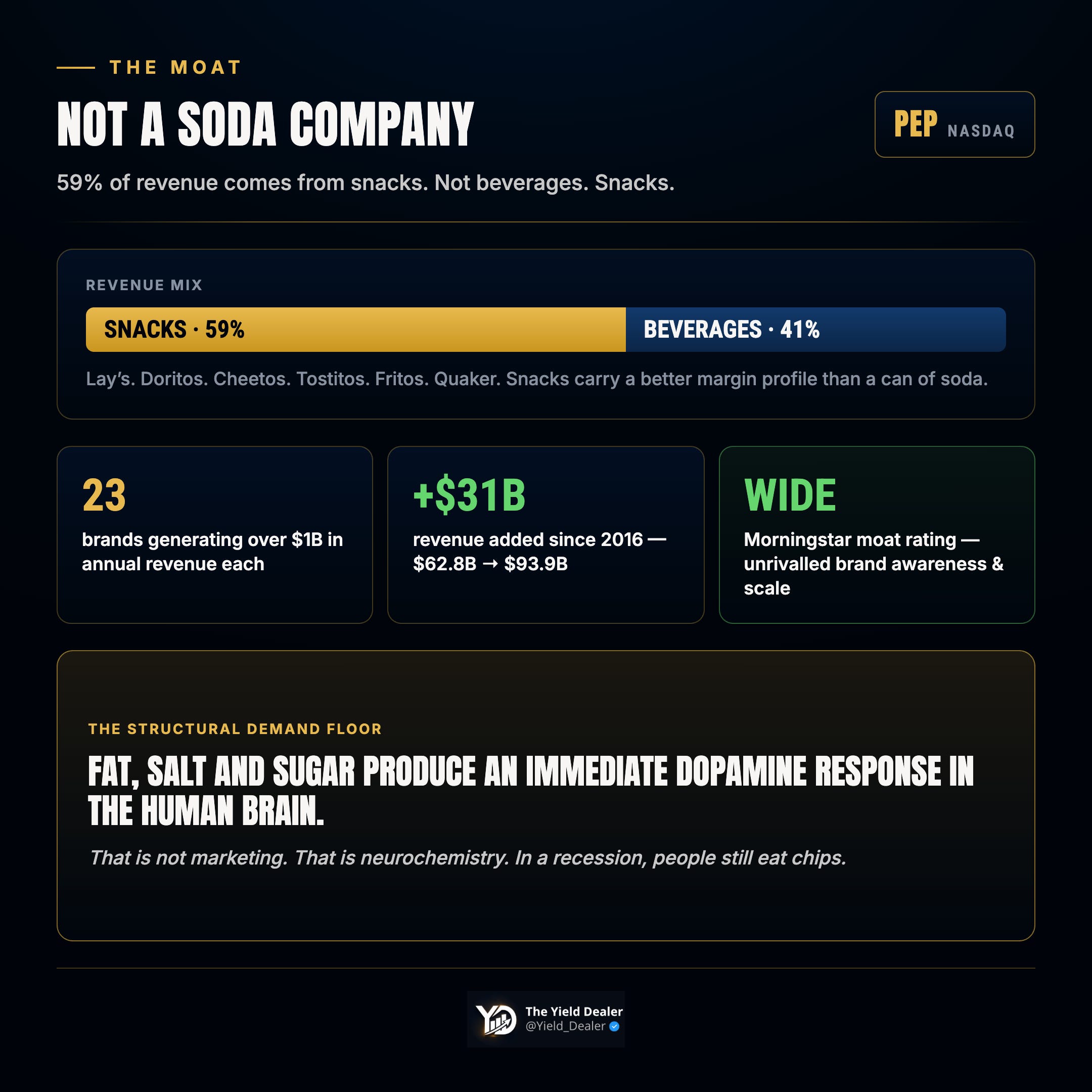
Lay’s. Doritos. Cheetos. Tostitos. Fritos. SodaStream. Quaker. The list goes on. PepsiCo has 23 individual brands that each generate over $1 billion in annual revenue. Twenty-three.
Total revenues have grown from $62.8 billion in 2016 to $93.9 billion in 2025. That is nearly $31 billion in additional revenue over a decade, compounding steadily without a single year of collapse.
The business also has a structural advantage that almost never gets discussed: snacks are more addictive and more profitable than beverages. The margin profile on a bag of Doritos is not the same as on a can of soda. And consumers — particularly when stressed, tired, or emotionally stretched — reach for salty, fatty, sweet things. That is not a trend. That is human biology.
As a side note: PepsiCo also holds a 39% stake in Tropicana, which most people forget entirely. It is not nothing.
The Q2 2026 Numbers: Mixed, But Not Broken
The most recent quarter is actually why the stock is where it is.
PepsiCo’s Q2 2026 results showed revenue of $24.18 billion, beating forecasts by $230 million, while EPS of $2.20 missed estimates by just $0.01. The market punished the stock anyway.
Here is what the numbers actually showed:
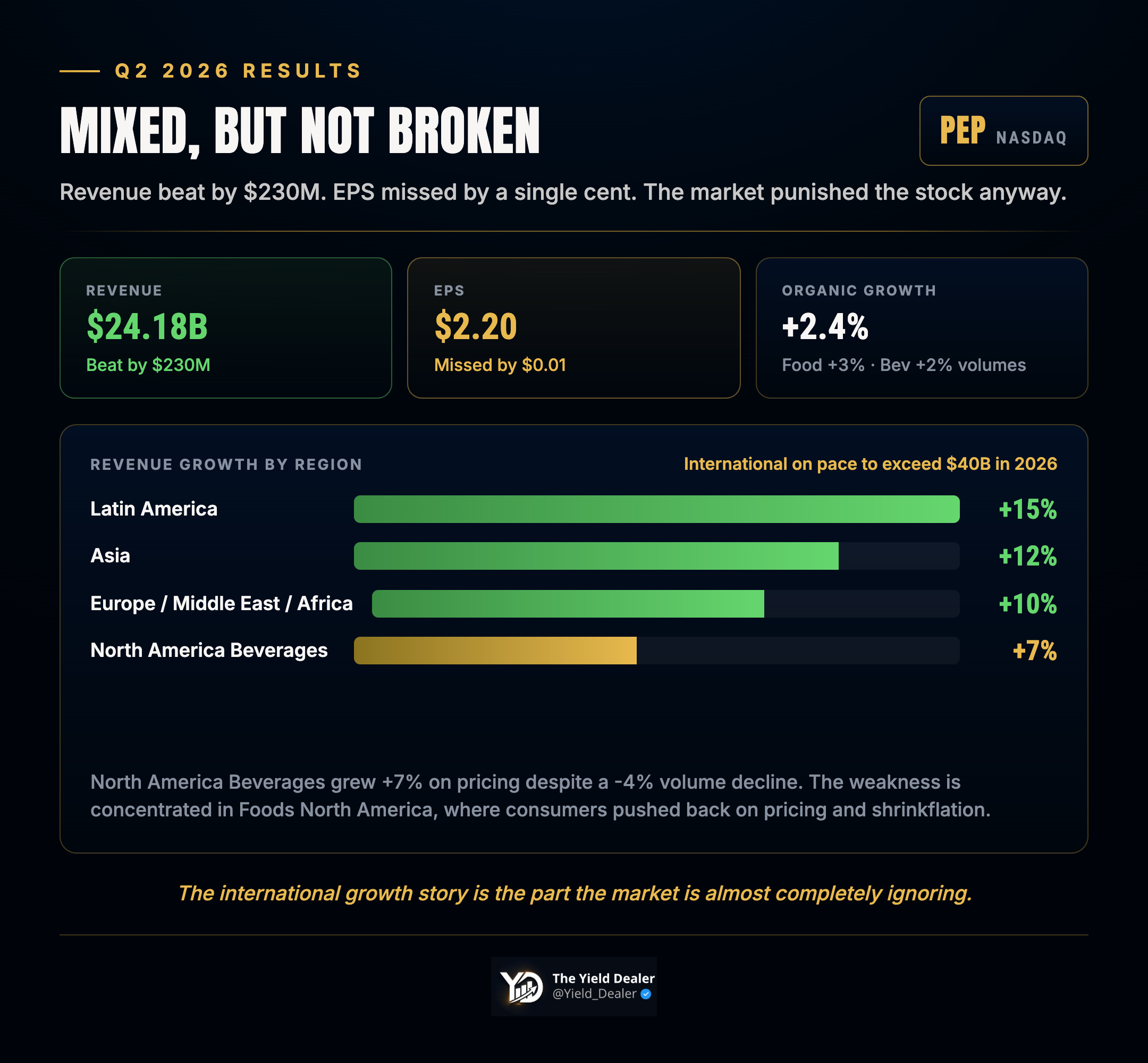
Organic revenue growth of +2.4% for the quarter
Food volumes up +3%, beverage volumes up +2%
North America Beverages revenue up +7% despite a -4% volume decline (pricing doing the work)
International business on fire: Europe/Middle East/Africa +10%, Asia +12%, Latin America +15%
International operations on pace to exceed $40 billion in 2026 revenue
The weakness is concentrated in North America. Specifically in snacks, where American consumers pushed back on pricing and “shrinkflation” — the practice of quietly reducing the amount of chips in a bag while keeping the price the same. That bad buzz is real, and it caused volume softness in PepsiCo Foods North America.
Management acknowledged this. They are already pivoting — more promotional activity, accessibility initiatives, value-focused SKUs.
The international growth story, meanwhile, is the part the market is almost completely ignoring.
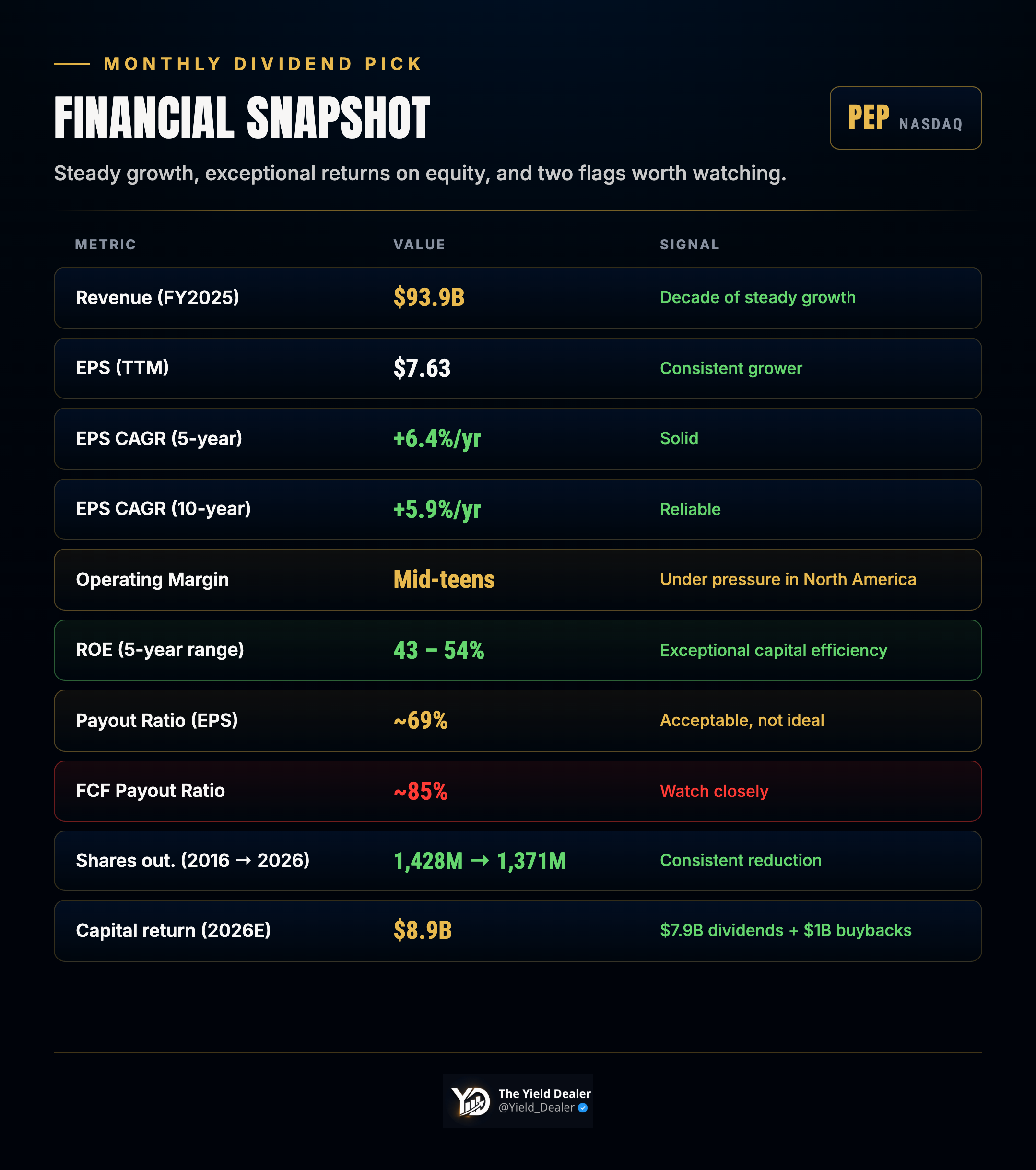
📊 Financial Snapshot
🏰 The Moat: Built on Human Weakness
I want to be blunt about why I think PepsiCo’s moat is more durable than most people give it credit for.
It is not just brand recognition.
It is not just distribution scale.
It is not just retailer relationships.
It is all of those things — reinforced by something that no regulation, health campaign, or economic downturn has ever managed to eliminate:
The combination of fat, salt, and sugar produces an immediate dopamine response in the human brain.
That is not marketing. That is neurochemistry.
PepsiCo has spent over a century building products around this response, at price points accessible to almost every income level, distributed through supply chains that reach essentially every country on earth.
Morningstar rates PepsiCo’s moat as Wide, citing unrivalled brand awareness, operational scale, and retail relationships that underpin snack market share — a position they see as unwavering.
I agree. But I would add one more dimension.
In a recession, people still eat chips. In an inflationary environment, a $3 bag of Doritos is still an affordable treat. During the last downturn, PepsiCo’s earnings kept growing — because when things get hard, consumers trade down from restaurants to grocery stores, but they do not trade away from their snack habits.
That is a structural demand floor. And it is very hard to replicate.
The “PepsiCo Positive” program — reformulating toward lower-sugar, lower-calorie, and “better for you” alternatives — also means PepsiCo is not standing still while health trends shift. The majority of their beverage volumes now meet their own sugar reduction standards. That is not a company being disrupted. That is a company adapting.
Finally, recent acquisitions of Poppi and Siete signal a deliberate move into higher-growth premium and health-adjacent categories. Smart capital allocation.
💰 The Dividend: 54 Years, and the Yield Has Never Looked Like This
This is the reason I am adding rather than waiting.
PepsiCo raised its dividend by 4.0% in February 2026, bringing the annualized payout to roughly $6.46 per share.
At $142, that is a yield of approximately 4.28%.
The 5-year median yield for PEP sits at around 3.02%. Meaning that right now, buying PepsiCo gives you a yield that is more than 40% above what has been considered normal over the last five years.
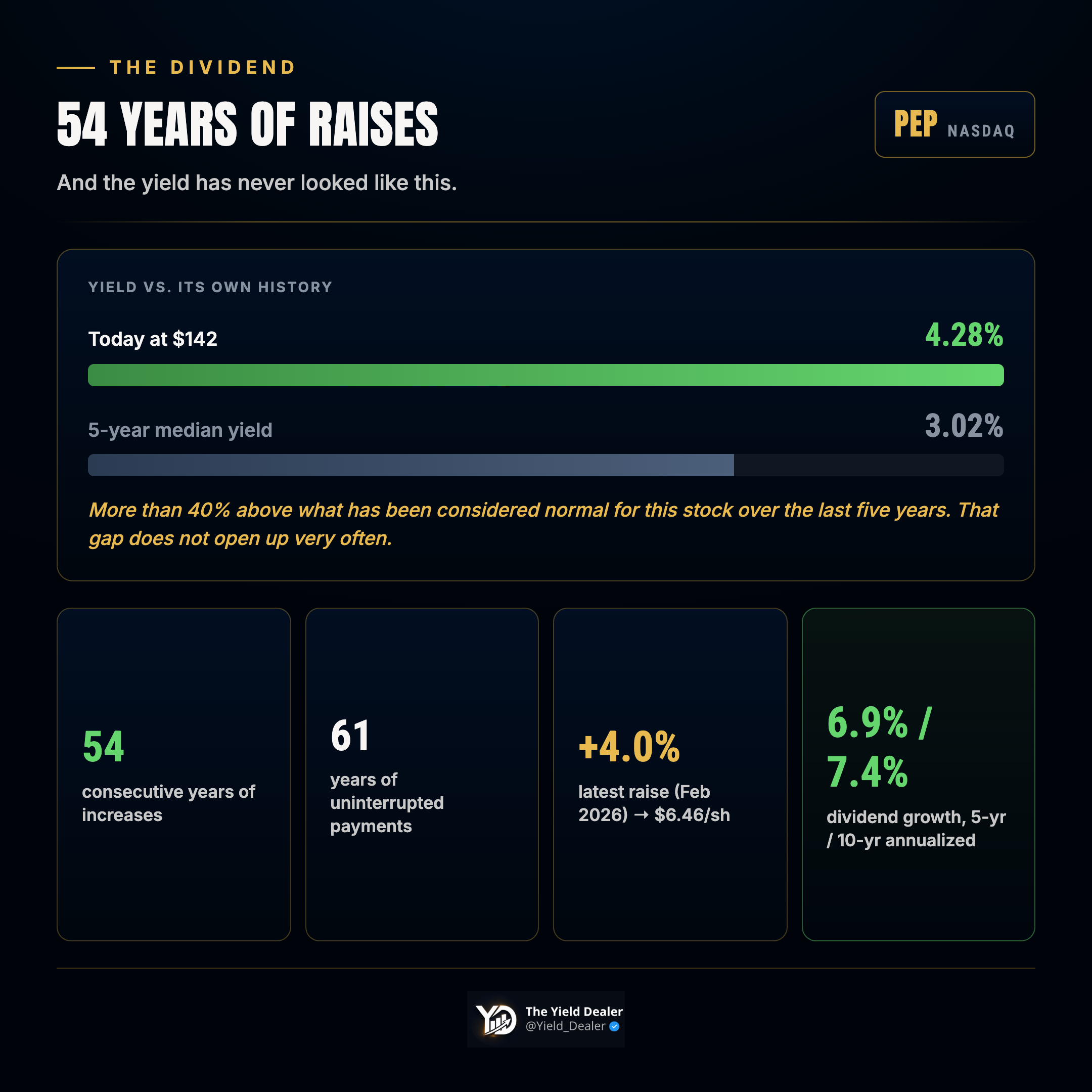
That gap does not open up very often.
54 years of consecutive dividend increases. 61 years of uninterrupted payments. The dividend has grown at roughly 6.9% per year over the last five years, and 7.4% per year over the last decade.
At $142, you are locking in a 4.28% yield that grows at ~7% per year on a business that has never cut its dividend in over six decades.
Run that math over ten years.
That is not exciting. That is genuinely powerful.
📐 Valuation: Bull / Base / Bear
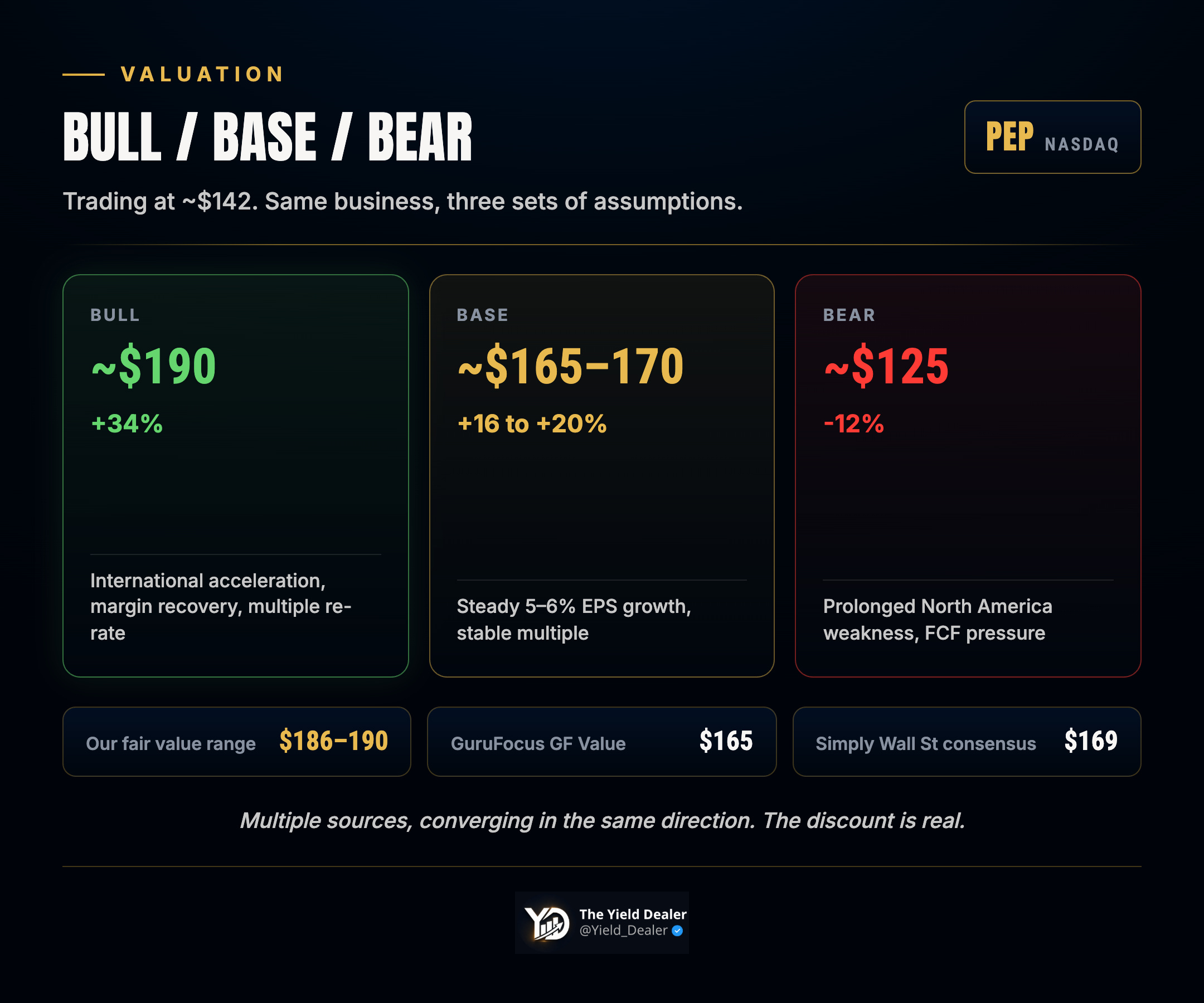
Our estimated fair value range sits at $186–190. At $142, PEP is trading roughly 25% below that estimate.
GuruFocus puts PEP’s GF Value at $165, placing the stock 17% below fair value. Simply Wall St’s updated analyst consensus fair value is approximately $169 per share.
Multiple sources, converging in the same direction. The discount is real.
The bear case is the one I take most seriously: if North American volume weakness persists longer than expected and margins keep compressing, the stock could drift lower. That is a genuine risk. But at a 4.28% yield and 25% below my fair value estimate, I am comfortable accepting that risk and adding in stages.
⚠️ The Real Risks
I am not going to skip over these.
North America margin pressure. Input cost inflation hit PepsiCo hard. They raised prices. American consumers pushed back. Volume fell. The shrinkflation narrative went viral. That is a real problem that management is actively trying to fix — but it will take time.
FCF payout ratio at 85%. This leaves less cushion than I would like. If earnings disappoint and FCF softens, the dividend is not threatened today — but the buffer is thinner than in prior years. This is the metric I will watch most closely every quarter.
Tariff exposure. With international revenues becoming a larger share of the business, currency and tariff risk is real. Management flagged tariff refund claims adding roughly 1 point to full-year EPS growth — which means tariffs are already a known headwind.
Consumer health trends. The long-term shift toward less processed food is real. PepsiCo is adapting, but it is a headwind they cannot fully escape.
None of these break the thesis. But I will not pretend they do not exist.
💵 Buy Zone
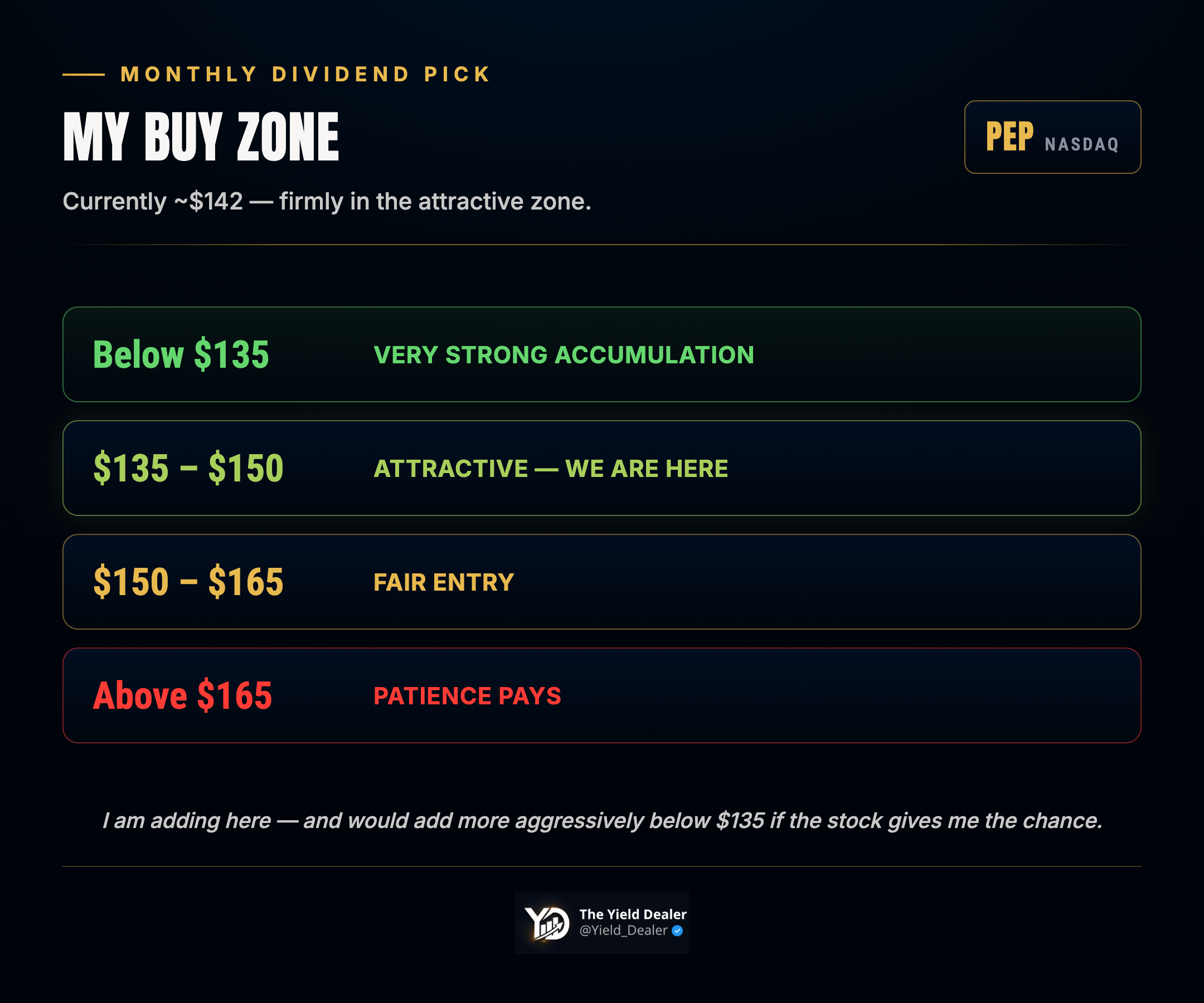
Below $135 - Very strong accumulation — rare opportunity
$135–$150 - Attractive for long-term dividend investors
$150–$165 - Fair entry, yield still above historical average
Above $165 - Back to historically normal territory — patience pays
At $142, we are sitting firmly in the attractive zone. I am adding here, and I would add more aggressively below $135 if the stock gives me that chance.
Why I Like PEP More Than KO Right Now
I get this question a lot.
Coca-Cola is often seen as the cleaner, simpler dividend compounder. And it is a great business.
But here is the argument I keep coming back to:
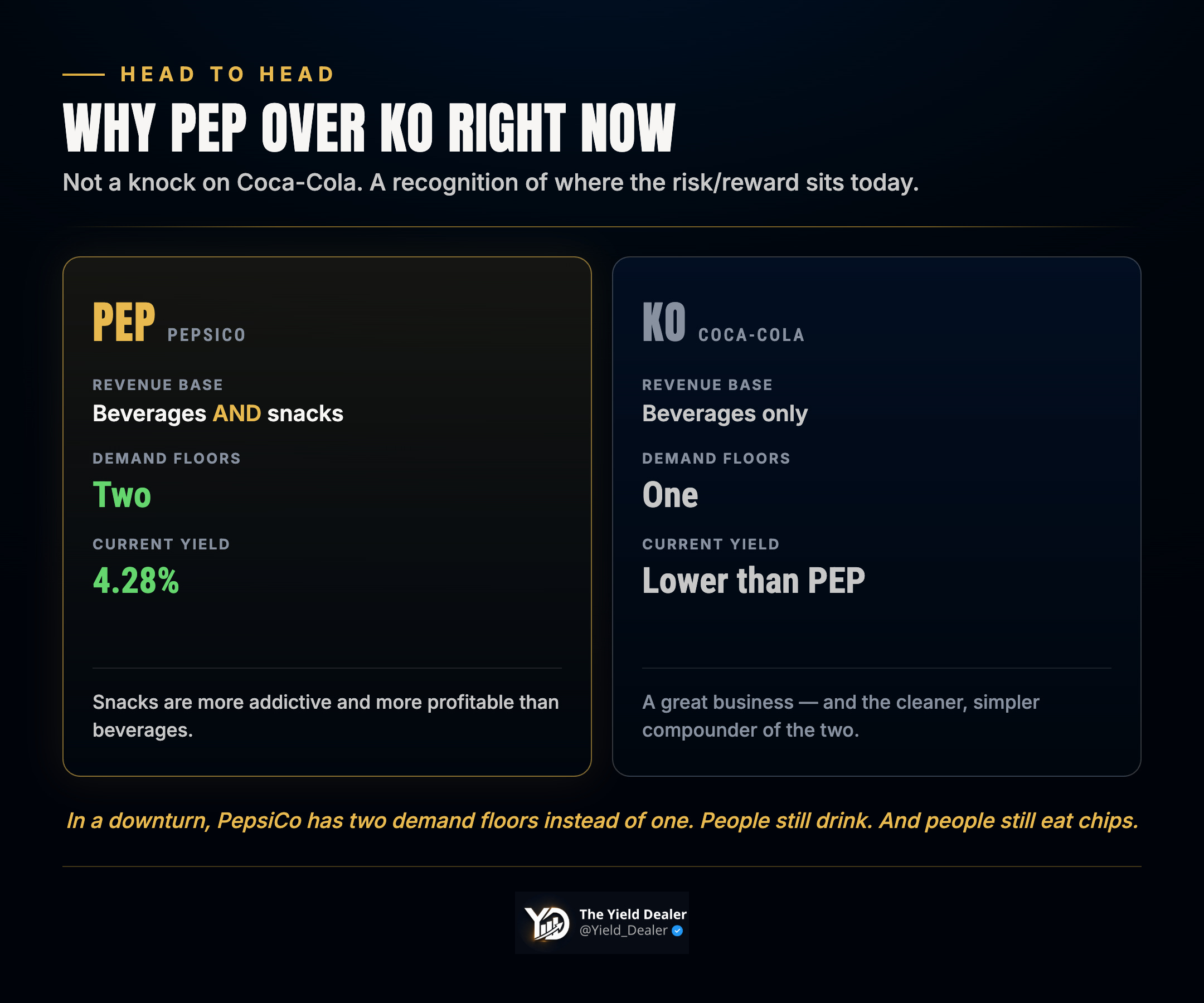
PepsiCo is diversified between beverages AND snacks. Coca-Cola is beverages only.
In a downturn — the scenario where defensive stocks are supposed to hold up — PepsiCo has two demand floors instead of one. People still drink. And people still eat chips.
Snacks, as I said earlier, are more addictive and more profitable than beverages. The emotional and behavioral drivers of snack consumption are arguably more resilient than those of soda consumption.
And PEP’s current yield at 4.28% is meaningfully higher than KO’s.
That is not a knock on Coca-Cola. It is a recognition that right now, the risk/reward skews in PEP’s favor.
My Decision
I am adding to PepsiCo this month.
Not because I am trying to call a bottom.
Not because the short-term story looks clean — it does not.
Not because North America is fixed — it is not.
I am adding because PepsiCo is exactly the kind of business I want more of in a dividend portfolio:
Essential.
Defensive.
Global.
Profitable through every cycle.
54 years of raising the dividend without interruption.
And I am adding because the yield is at a generational level for this stock, the valuation discount is real, and the long-term tailwinds — a growing global middle class, urbanization, the structural demand for affordable pleasure — are still very much intact.
The world is not going to stop eating chips.
And as long as that is true, PepsiCo will keep printing cash, raising its dividend, and quietly compounding in portfolios that have the patience to hold it.
54 years of proof is enough for me.
Also On My Watchlist
A few other names were actively tracked this month alongside PEP:
ADP / Automatic Data Processing (2.49% yield, ~20% undervalued) — already covered last month. Still on the list.
BR / Broadridge (2.53% yield, ~20% undervalued) — up +15% in a month, patience required.
MCD / McDonalds (2.78% yield, ~10% undervalued) — starting to reach levels that get interesting.
ABT / Abbott (2.81% yield, ~20% undervalued) — up +27% in a month, wait for it to breathe.
BDX / Becton Dickinson (2.28% yield, ~20% undervalued) — on the radar.
PEP was the clear choice this month. The discount, the yield, and the conviction in the business made it easy.
Thanks for being a paid member of The Yield Dealer.
Your support makes this research possible — and it allows me to keep building a serious dividend investing publication focused on cash flow, valuation, and long-term compounding instead of market noise.
I’ll be back next month with another Monthly Dividend Pick: one company, one thesis, one valuation range, and one clear decision.
Until then: boring is welcome, cash flow is mandatory.


Sources: PEP quarterly earnings releases and SEC filings, ADP investor relations materials, and third-party data from Morningstar, GuruFocus, and Alpha Spread, as of August 14, 2026.
Disclaimer: This is a record of my own investment research and personal investing decisions. It is not personalized financial advice. I am not a financial advisor. Do your own due diligence and check current prices, filings, and company updates before making any investment decision.