


ROE (Return on Equity) is one of the most widely used ratios in all of investing. Its purpose is simple: it measures how much profit a company generates with the money that belongs to its shareholders. But behind that simple number hides real nuance — and a few traps that fool even experienced investors.
What is ROE?
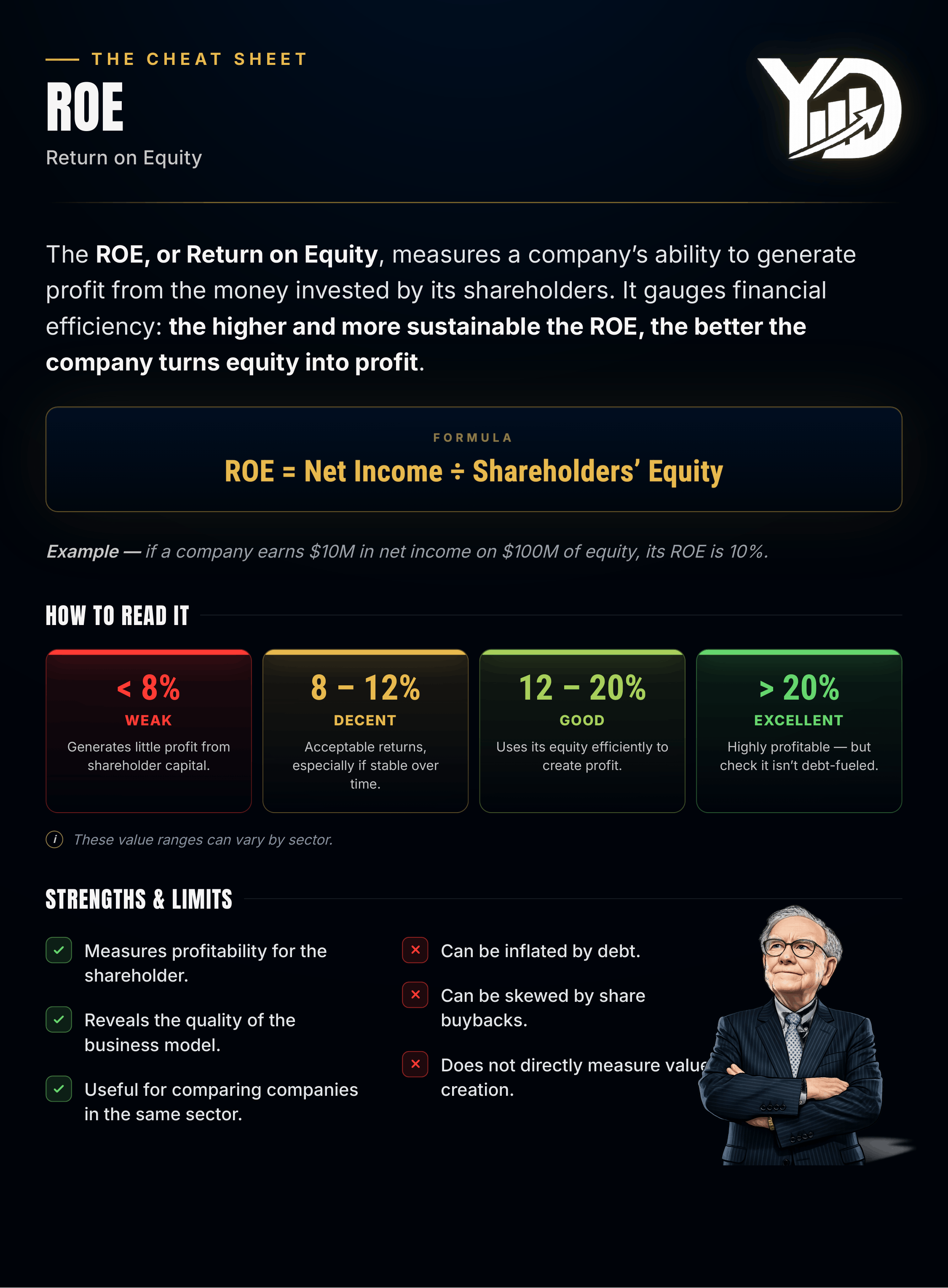
ROE answers one question: for every dollar shareholders have put into the business, how many dollars of profit does it produce each year?
Formula: ROE = Net Income ÷ Shareholders’ Equity
Shareholders’ equity is, simply put, the portion of the company financed by its owners plus the profits it has retained over time. Net income is the bottom-line profit — after costs, interest, and taxes.
Example: A company earns $10M in net income on $100M of equity. Its ROE is 10% — it generates $10 of profit for every $100 of shareholder capital.
At first glance, higher is better. A company with a 20% ROE looks more efficient than one at 6% — it turns equity into profit more effectively. But as so often in financial analysis, never stop at the raw number.
A high ROE can signal a great business…
When ROE is high and consistent over many years, it can point to a solid business model: strong profitability, a powerful brand, a durable competitive advantage, or excellent management discipline. A company that sustains a high ROE for a decade usually proves it uses its shareholders’ capital efficiently.
…but a high ROE isn’t automatically a sign of quality
This is where most investors get caught. A high ROE can be inflated artificially — and the number alone won’t tell you.
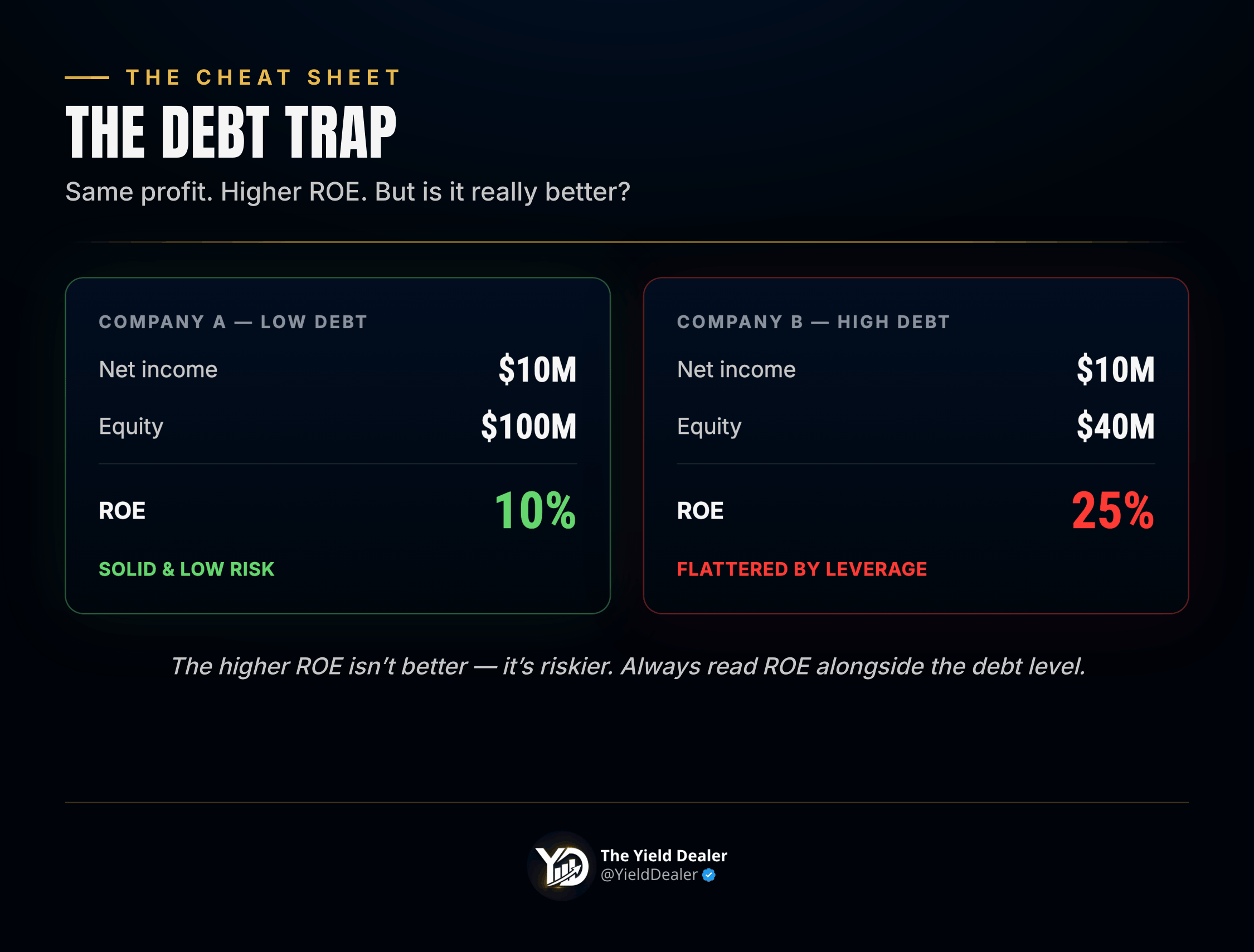
⚠️ Trap #1 — Debt. When a company borrows heavily, equity becomes a smaller slice of its total financing. Profit is then measured against a smaller equity base, which pushes ROE up. On the surface, profitability looks excellent. In reality, the company may simply be taking on more financial risk.
Consider two companies, each earning $10M:
Company A — $100M of equity → ROE of 10%
Company B — only $40M of equity (far more debt) → ROE of 25%
Company B looks better, but that number may just reflect greater leverage. If business slows, the more indebted company is usually the more fragile one. Always read ROE alongside the debt level — a high ROE with little debt is far more reassuring than one built on a heavily loaded balance sheet.
⚠️ Trap #2 — Buybacks. When a company buys back its own shares, it typically reduces book equity. Net income is then divided by a smaller base, mechanically lifting the ratio. This isn’t necessarily bad — buybacks done at the right price create real value — but they can make ROE harder to read.
⚠️ Trap #3 — One-time items. ROE uses net income, which a single year can distort: an asset sale, a writedown, a legal charge, a tax effect, or a one-off gain can swing the bottom line. Look at ROE over several years, not one. A 18% ROE sustained for ten years is worth far more than a 30% ROE hit once thanks to an exceptional event.
Context is everything: compare within a sector
ROE only makes real sense against close competitors. Banks, insurers, industrials, software companies, and luxury groups have very different capital needs and balance-sheet structures. A “decent” ROE in one sector can be weak in another.
For banks and insurers, ROE is especially important — they operate with large amounts of regulatory capital, so their ability to generate a strong return on equity is central. For industrial or tech companies, ROE stays useful but should be paired with other ratios like ROIC, ROCE, or free cash flow.
ROE ≠ value creation
One crucial point: a high ROE doesn’t directly measure value creation. A company truly creates value only when its returns exceed the cost of the capital it uses. A business can post a healthy ROE yet destroy value if it takes on too much risk, if its profits don’t convert into cash, or if that profitability isn’t durable.
The questions to ask before trusting an ROE
Run the number through a quick checklist:
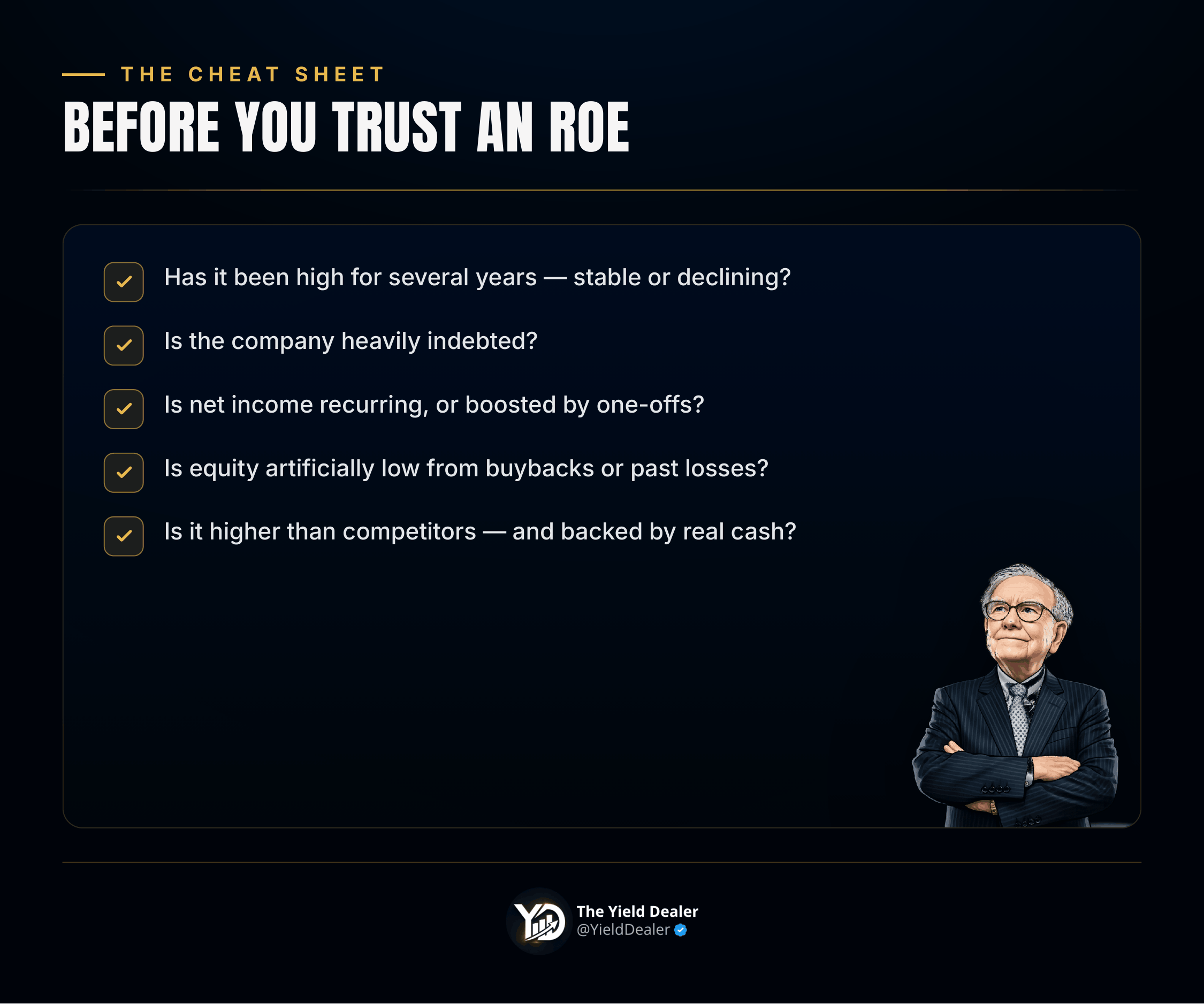
Has ROE been high for several years — is it stable, or declining?
Is the company heavily indebted?
Is net income recurring, or boosted by one-offs?
Is equity artificially low because of buybacks or past losses?
Is ROE higher than competitors’?
Does the company turn its profits into actual cash?
How to read the number
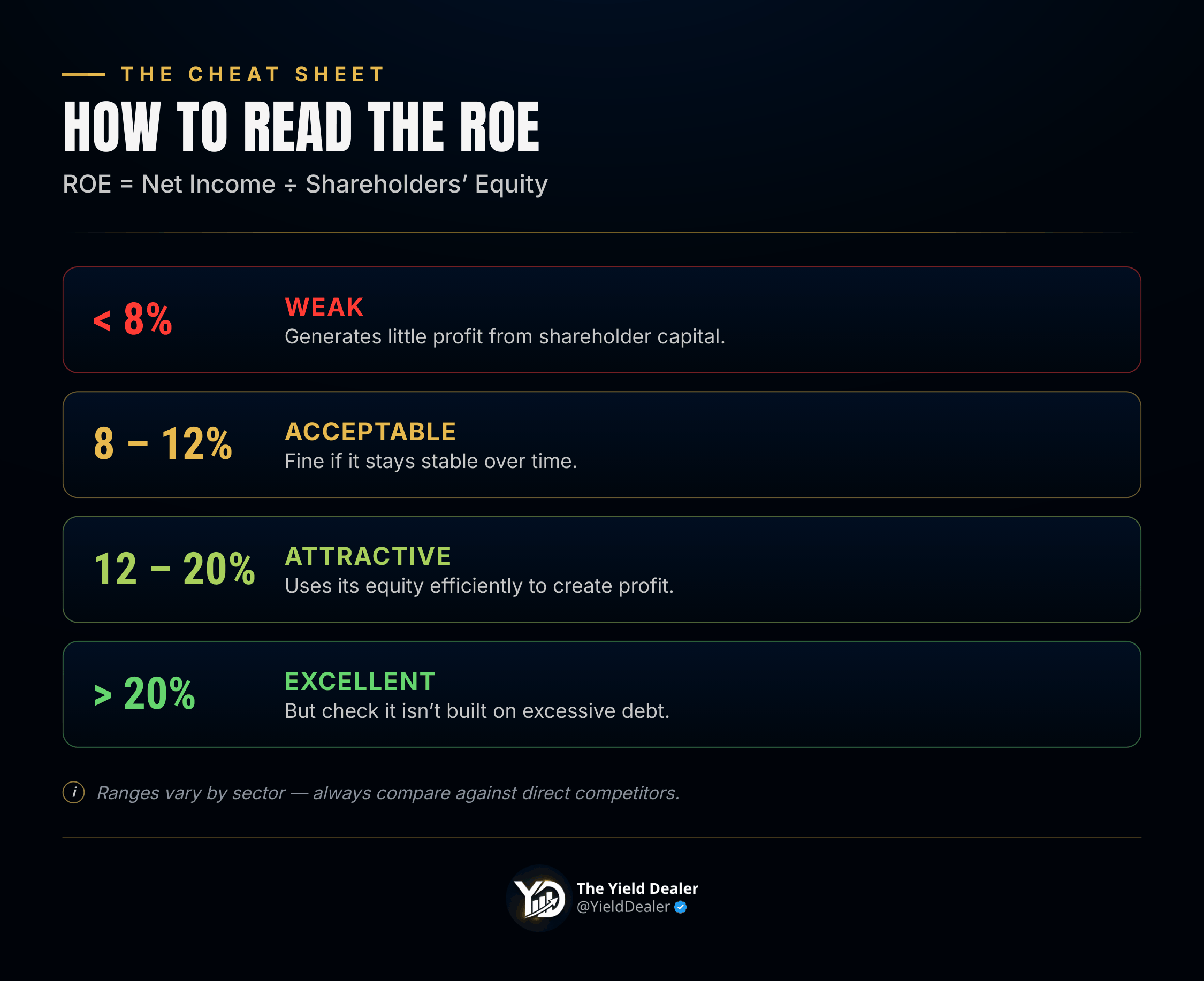
Below 8% — usually weak, barring special cases.
8 – 12% — acceptable if it’s stable over time.
12 – 20% — genuinely attractive.
Above 20% — potentially excellent — but check it isn’t built on excessive debt or an artificially shrunken equity base.
Bottom line
ROE measures a company’s ability to generate profit from its shareholders’ capital. It’s a simple, useful, and revealing ratio — but it must always be read with nuance.
A good ROE isn’t merely a high one. It’s a durable ROE, achieved with a healthy balance sheet, recurring earnings, strong cash generation, and a solid business model.
For an investor, ROE is an excellent starting point — it helps flag profitable, well-run companies. But before concluding a business is high quality, always look at what’s hiding behind the number.


Want to get The Yield Dealer’s Newsletter in your inbox? Join other readers here.
Want short ideas on living and working on your own terms? Follow me on X/Twitter and Instagram.