

Every March, the same conversation starts all over again.
“Why did SCHD remove Cisco?”
“Why would they sell AbbVie?”
“Who thought adding UnitedHealth was a good idea?”
The funny thing is...
There is no “they.”
SCHD doesn’t have a portfolio manager making calls based on headlines or market sentiment.
It follows a set of rules.
Every year, those rules are applied again. Companies that score well stay. Companies that don’t leave. That’s it.
Simple.
Predictable.
Sometimes frustrating.
But that’s exactly why so many investors trust the fund.
SCHD Doesn’t Make Predictions
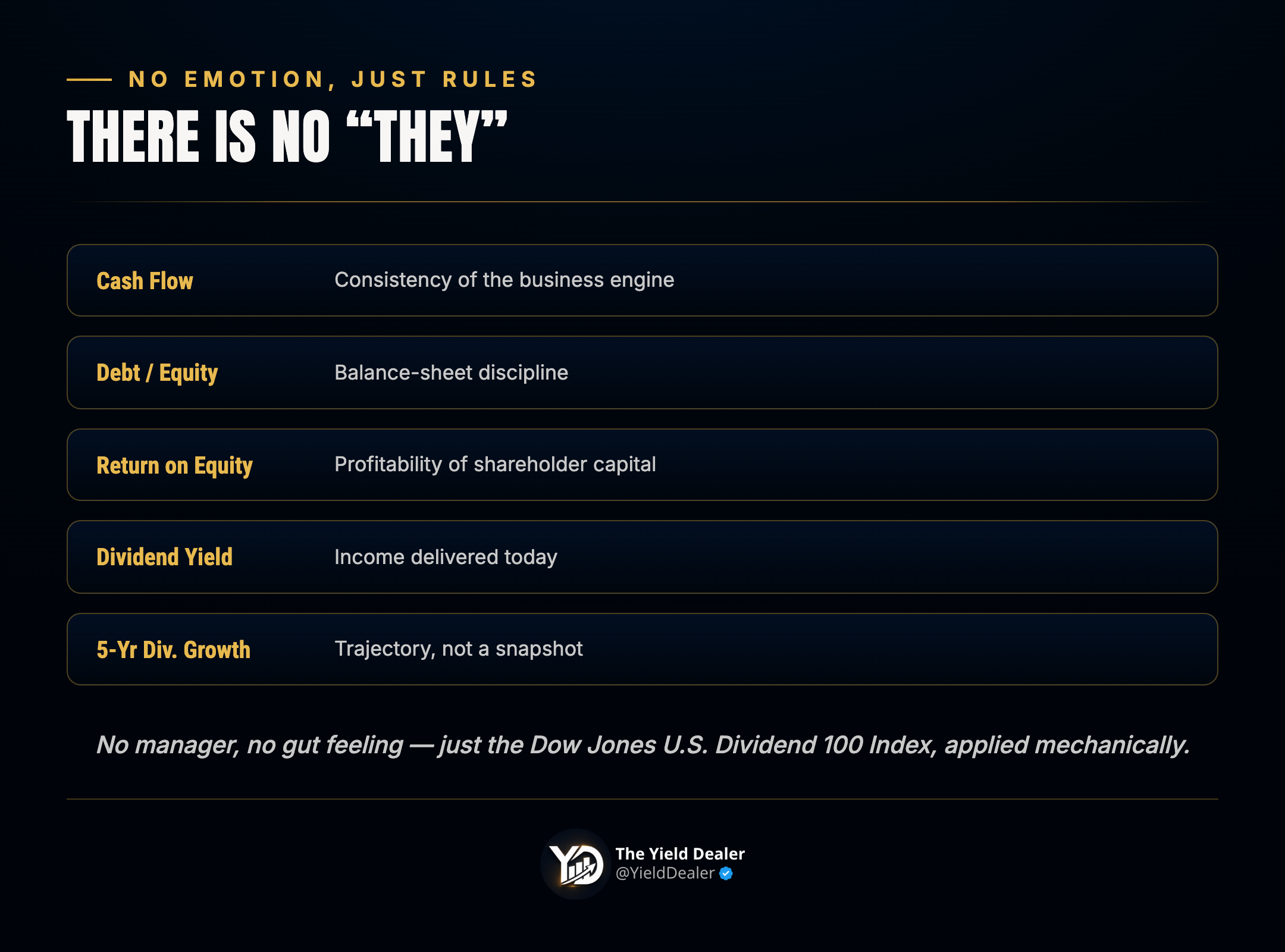
SCHD tracks the Dow Jones U.S. Dividend 100 Index.
The index ranks companies using a combination of profitability, cash flow, balance-sheet strength, dividend yield and dividend growth.
It doesn’t ask whether AI is the future.
It doesn’t care whether oil prices might surge next month.
It doesn’t read earnings call transcripts or watch CNBC.
It simply compares companies using the same methodology every year.
That’s one of the biggest misunderstandings surrounding SCHD.
People often talk about the ETF as if someone is actively choosing which companies deserve to stay.
They’re not.
The rules are.
2026 Wasn’t a Small Adjustment
This year’s rebalance was larger than usual.
Nearly two dozen holdings changed.
Energy exposure fell sharply.
Materials disappeared entirely.
Healthcare gained weight.
Technology became a bigger part of the portfolio.
Looking at the new allocation, some investors felt SCHD was drifting away from its identity.
I don’t think that’s what happened.
The strategy didn’t change.
The rankings did.
Companies with stronger fundamentals moved higher.
Others didn’t make the cut.
Whether the market agreed was another story.
Then Energy Took Off
Only a few months later, the market threw SCHD a curveball.
Energy became one of the best-performing sectors of the year.
Oil prices climbed as geopolitical tensions involving Iran intensified.
Suddenly, several companies SCHD had just removed looked like brilliant investments.
Cisco rallied.
Valero rallied.
AbbVie kept doing what AbbVie usually does.
I’ll admit it.
When I first looked at the performance numbers, my first thought was:
“Did SCHD get this one wrong?”
It’s a fair question.
But it’s also a dangerous one.
Because we’re judging a long-term process using only a few months of data.
SCHD never claimed it could predict geopolitical events.
Its job isn’t to forecast oil prices.
Its job is to own companies with the strongest fundamentals according to its methodology.
Those aren’t the same thing.
The Deleted Stocks Actually Won
Here’s the part that surprised me most.
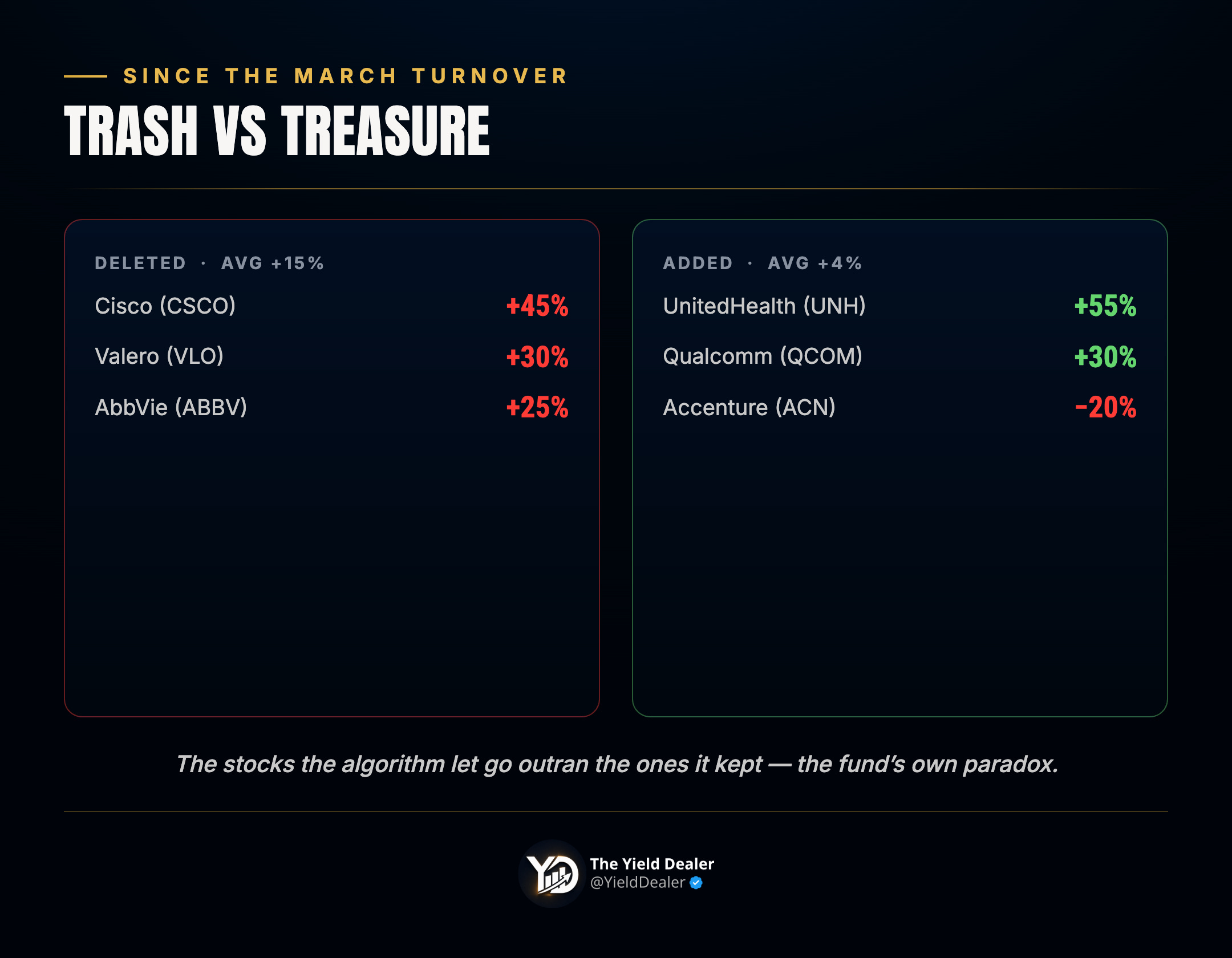
Since the March reconstitution, many of the deleted companies have outperformed the new additions.
Cisco gained roughly 45%.
Valero and AbbVie also posted impressive returns.
Among the additions, UnitedHealth and Qualcomm delivered strong gains.
Accenture, on the other hand, became one of the biggest disappointments.
If you stopped the clock today, you’d probably say SCHD sold too early.
Maybe it did.
But that’s the nature of every systematic strategy.
Sometimes the stocks you sell keep running.
Sometimes the ones you buy take longer to prove themselves.
That’s not necessarily a flaw.
It’s simply what happens when you follow a process instead of chasing momentum.
The Bigger Picture Isn’t About Cisco
One thing stood out as I went through the numbers.
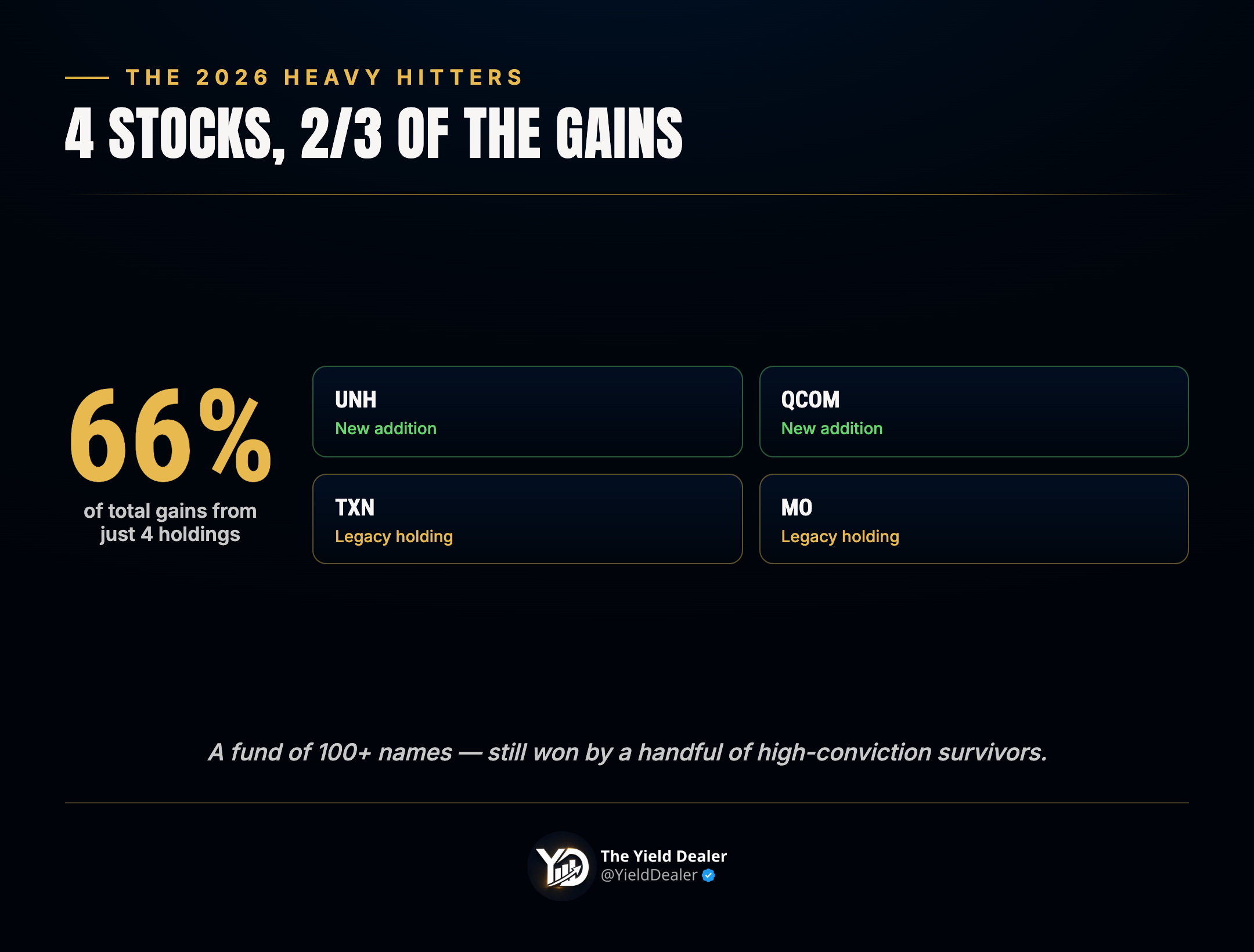
SCHD’s returns are still driven by a relatively small group of holdings.
Just four companies generated roughly two-thirds of the fund’s gains since the rebalance.
Two of them were new additions.
Two were already in the portfolio.
That’s worth remembering.
Every year, investors spend weeks debating the companies that leave.
Far fewer talk about the businesses quietly doing the heavy lifting.
Sometimes we focus so much on the exits that we forget to appreciate what’s still inside the portfolio.
My Take
I don’t think the 2026 reconstitution proves SCHD made a mistake.
